OCR Post-Correction With Language Models in Document Pipelines
Language models catch OCR errors that rule-based tools miss, but they introduce new failure modes.
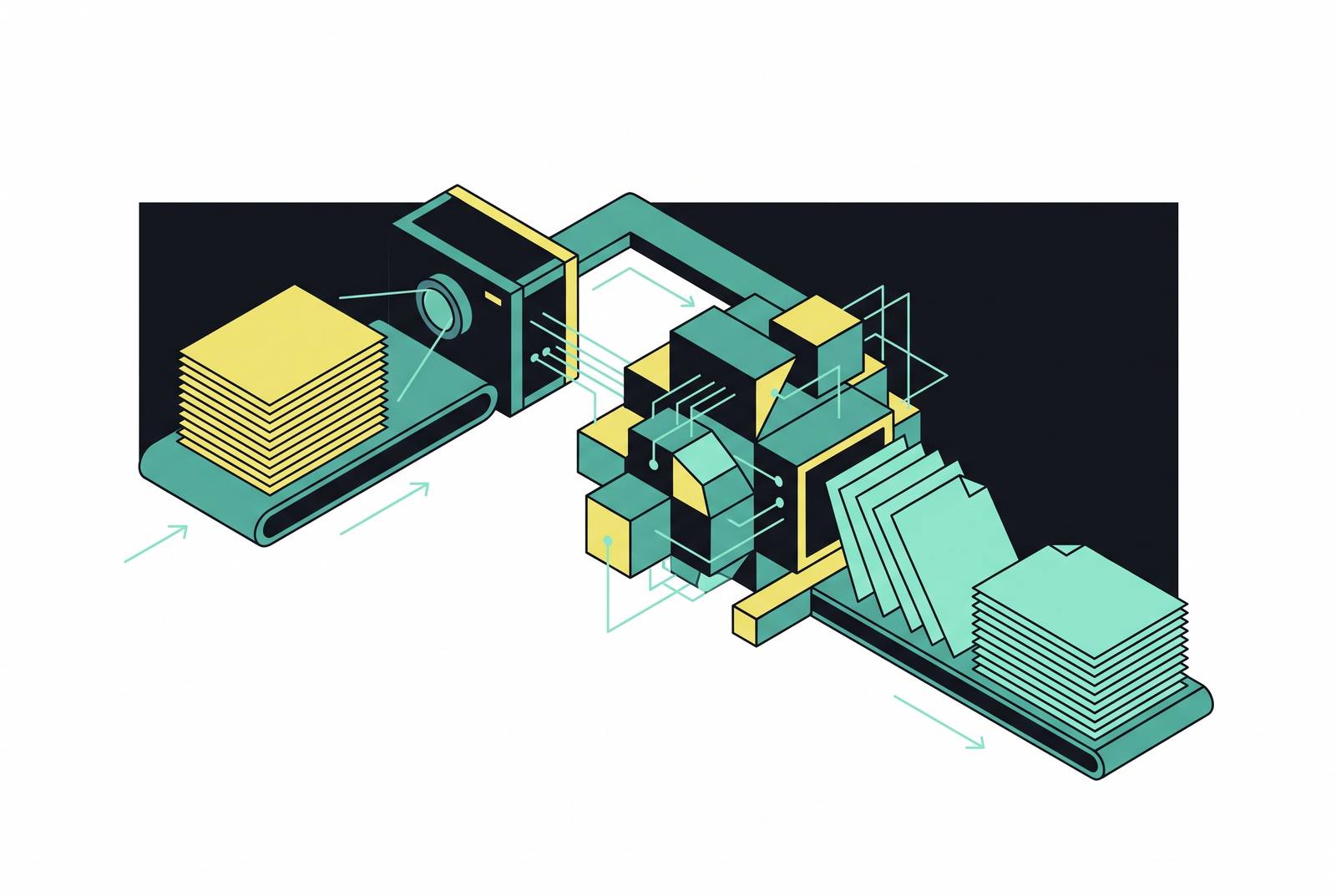
A system that reports very high character accuracy sounds finished. On a document running a few thousand characters, though, that remaining fraction is dozens of individual errors, and dozens of errors is more than enough to send a document to manual review, corrupt a search index, or quietly poison a retrieval pipeline downstream. This piece looks at how large language models have become a working layer for fixing OCR mistakes that older rule-based tools miss, and, more importantly, where that layer breaks and what to do about it.
Some context on what "good" even means here. Character error rate (CER) benchmarks for printed text put good accuracy around 1 to 2%, average performance somewhere between 2 and 10%, and anything above 10% counts as poor. Handwritten text tops out lower still; handwriting recognition simply has a harder ceiling. OCR errors don't behave like human typos, though. A person fat-fingering a keyboard makes mistakes clustered around phonetics and muscle memory: "teh" for "the," adjacent keys swapped. OCR errors cluster around font shape, scan quality, and page layout instead. A serif "rn" becomes "m." A watermark bleeding through the page turns a clean word into a fragment. These are structurally different error distributions, which matters more than it sounds like it should, because it means the tools built to catch human typos were never aimed at the right target.
The downstream stakes are where this stops being a curiosity and starts being an actual argument. Liu et al. (2023) found that retrieval accuracy in RAG systems drops measurably as OCR noise increases, meaning a document doesn't have to be badly scanned to already be corrupting the answers a retrieval system gives back. Zhang et al. (2024) went further and found that even state-of-the-art OCR often fails to produce a knowledge base clean enough for reliable retrieval once the source documents carry their own formatting and semantic noise. Piryani et al.'s MultiOCR-QA (2025) showed question-answering performance degrading in step with character-level OCR errors, across multiple languages, further reinforcing the pattern. Put simply: cleaning OCR output is a precondition, not a nice-to-have preprocessing chore. Skip it, and every downstream NLP task inherits the mess.
How post-correction methods evolved before LLMs entered the picture
Before anyone thought to point a language model at garbled scans, the tools were blunter. Dictionary lookups and spelling checkers handled the easy cases: common words with an obvious correct spelling nearby in edit distance. Proper nouns, archaic spellings, and anything domain-specific defeated them, though, since a spell-checker has no way to know that "Throgmorton" is a real street and not a typo.
Discriminative feature-based classifiers came next, widening the net a bit by learning statistical signals about which corrections tend to be right. That improved coverage, but it required hand-engineered features, meaning someone had to sit down and decide which signals mattered, which doesn't scale well across document types or languages.
Then came neural sequence-to-sequence models, borrowing directly from machine translation. BERT-style and NMT-style encoders reframed the whole task: treat the noisy OCR output as the "source language" and the clean text as the "target language," and let the model learn the mapping. This was a real conceptual jump, because it let the model absorb context and pattern rather than rely on a lookup table.
Even these models operated character- or token-locally, though, meaning they struggled with the kind of error that only makes sense once you've read the rest of the paragraph, a garbled place name that's perfectly obvious in context but ambiguous in isolation, for instance. All of these methods, from dictionaries onward, ran into the same wall: paired noisy/clean training corpora are rare, especially for historical documents and non-English languages. That scarcity is what makes large pretrained language models tempting. They arrive already knowing vocabulary, syntax, and a fair amount of domain context, learned from enormous volumes of clean text, without needing a matched pair of "bad" and "good" versions of the same document.
The two ways LLMs are applied to OCR post-correction
There are two broad playbooks in use, and the difference between them is really a question of what data is on hand.
The first is fine-tuning: take a pretrained model and adapt it specifically to post-correction using paired noisy-OCR/clean-text examples. Soper et al. (2021) fine-tuned BART on ICDAR 2017 English newspaper data. Veninga (2024) fine-tuned ByT5 on ICDAR 2019 data. The advantage is that the model learns the actual error distribution of the target corpus, not some generic notion of "OCR mistakes." The cost is obvious: it needs enough paired training data, which for niche document types or low-resource languages, often just doesn't exist.
The second is zero-shot or few-shot prompting: hand an LLM the noisy text and ask it to fix it, no task-specific training involved. GPT-3.5-turbo, GPT-4, and GPT-4-turbo have all been applied this way to the Princeton Prosody Archive texts, presented at ACM DocEng 2024. Open-weight models have been tested similarly on English and Finnish historical datasets at ACL 2025. This approach skips the training pipeline entirely and adapts to new domains just by changing the prompt, which is appealing right up until it isn't; the model has no built-in signal about what kind of errors to expect in this specific corpus, and that opens the door to over-correction, a topic worth sitting with in the next section.
There's a third direction gaining ground: multimodal prompting, where the model sees the original scan image alongside the noisy transcript, rather than the transcript alone. That changes the nature of the task in a way that turns out to matter quite a bit, and gets its own treatment further down.
Choosing between fine-tuning and prompting isn't purely a technical decision. It's a data-availability and latency question first. If paired data exists and speed matters, fine-tune. If it doesn't, or the corpus shifts often enough that retraining is a hassle, prompting is the practical fallback, warts and all.
What the evidence actually shows about LLM correction quality
Here's where the numbers start to carry the argument instead of the intuition.
CLOCR-C, published by Bourne in IJDAR in April 2025, fine-tuned a model on text that had been synthetically corrupted using a character-level Markov process, meaning corruption applied with some randomness but following patterns similar to real OCR noise. The result: a 55% reduction in CER and a 32% reduction in word error rate (WER) over the base language model, and notably, this synthetic approach outperformed models trained on real paired data. That's a genuinely odd result worth sitting with: fake noisy data, constructed carefully, beat real noisy data at teaching a model how to fix noisy data. The paper's practical heuristics are specific enough to use directly: under-corrupted synthetic data beats over-corrupted data, non-uniform character-level corruption beats uniform corruption, and for a fixed token budget, more tokens per training example beats more separate examples.
Multimodal correction tells a parallel story. Greif et al. (arXiv, April 2025) fed the original scan image alongside the noisy Transkribus transcript into a multimodal LLM and saw accuracy improve by up to 30.7% over uncorrected text, beating text-only correction approaches outright. The mechanism is intuitive once stated: giving the model the image turns the task from "guess what this word probably meant" into "spot where the transcript disagrees with the picture," which is a fundamentally easier and safer job. Named entity recognition benefited too, up 10.5% over text-only approaches in the same study.
Zero-shot prompting with GPT models on historical prosody texts (ACM DocEng 2024) found that adjusting temperature helps, while tailoring prompts with document metadata helps less than expected, a small but telling reminder that intuitive-sounding tweaks don't always pay off. The HIPE-OCRepair-2026 competition found LLM-based systems, notably the BNF-MISTRAL entries, achieving real gains over raw OCR on multilingual historical collections, even without source images and at controlled noise levels around 3% and 7% CER.
The pattern across nearly all of these studies is consistent: gains are strongest when OCR noise is moderate to high. Feed a model text that's already fairly clean, and the correction step is more likely to make things worse, since there's less genuine error to fix and more room for the model to "fix" something that wasn't broken.
Where LLMs fail and why hallucination is a structurally different problem here than in generation tasks
The same generative capacity that lets an LLM infer a plausible correction is the capacity that lets it invent text that was never on the page. That's not a minor caveat; it's the central tension of the whole approach.
For historical and archival material, this isn't a stylistic quibble. These documents are primary sources. Silently modernizing an archaic spelling or inserting a plausible-sounding word that fills a gap in the scan is an alteration of the historical record, and the two should not be confused with each other even though they might look identical in a clean-text output.
Over-correction shows up consistently across the research. In some multilingual historical settings, every model tested actually degraded the transcription rather than improving it. The ACL 2025 study, titled with a fittingly blunt "No Free Lunches," found GPT-4o showing the most promise across both English and Finnish, yet still falling short of practically useful performance for Finnish. Language dependence here is sharp: strong results on English historical text do not transfer cleanly to lower-resource or morphologically complex languages. Handwritten text recognition tells a similarly uneven story. In benchmarks from 2025, only the top proprietary models showed improvement, while every open-source model tested actually increased error rates. Self-correction techniques that show real gains on printed OCR haven't produced comparable results on handwriting, either; the two domains behave differently enough that treating them as interchangeable is a mistake.
There is, at least, one detectable warning sign. Per FedCSIS 2025 analysis, long consecutive insertion sequences in a model's output, strings of new content added in a row, are a workable indicator of hallucination, and crucially, they can be flagged algorithmically without needing a ground-truth reference to compare against. That's a rare bit of good news in this section: the flag doesn't require already knowing the right answer.
What LLMs cannot reliably do, per the current research record, is catch their own mistakes. Ask a model to correct OCR output and then ask it to double-check its own correction, and there's no strong evidence that second pass is meaningfully better than the first. Self-correction, as a safety net, doesn't hold much weight.
How to structure a pipeline that captures LLM gains without propagating their errors
None of the above means LLM correction should be avoided. It means the pipeline around it needs to be built like it's handling something that occasionally lies with confidence, because it is.
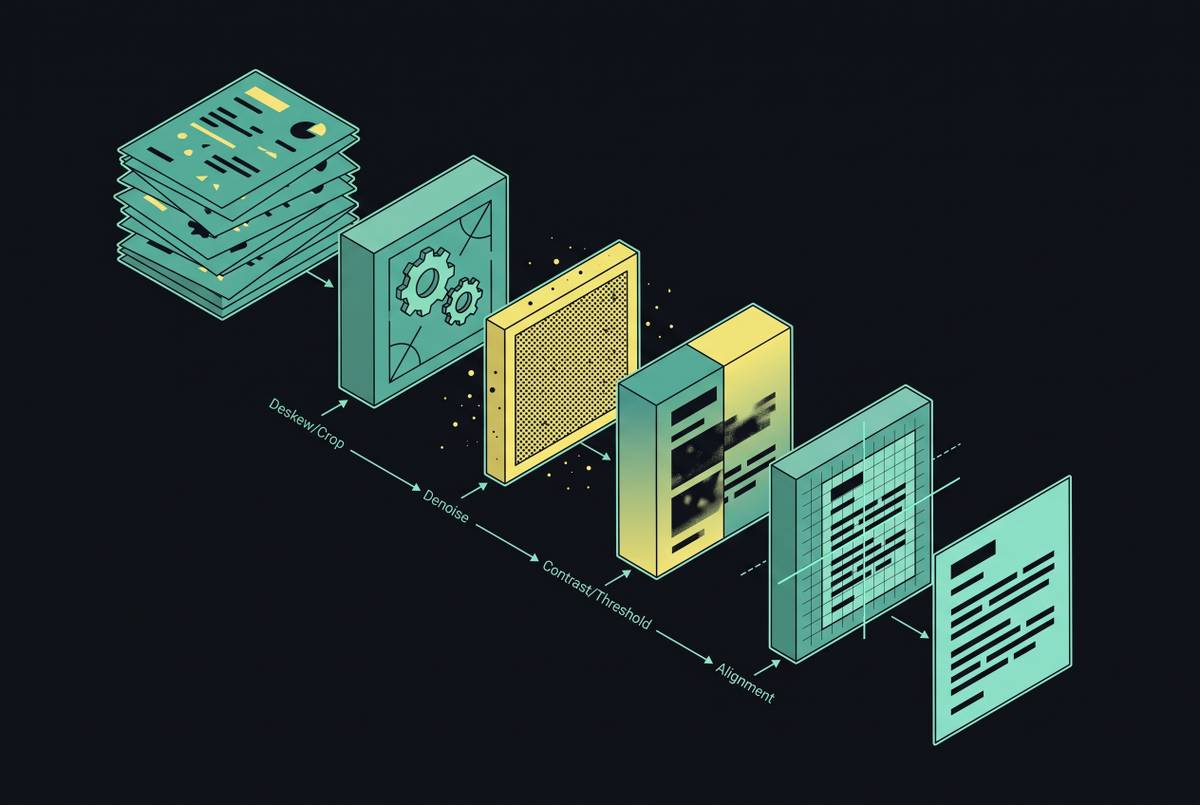
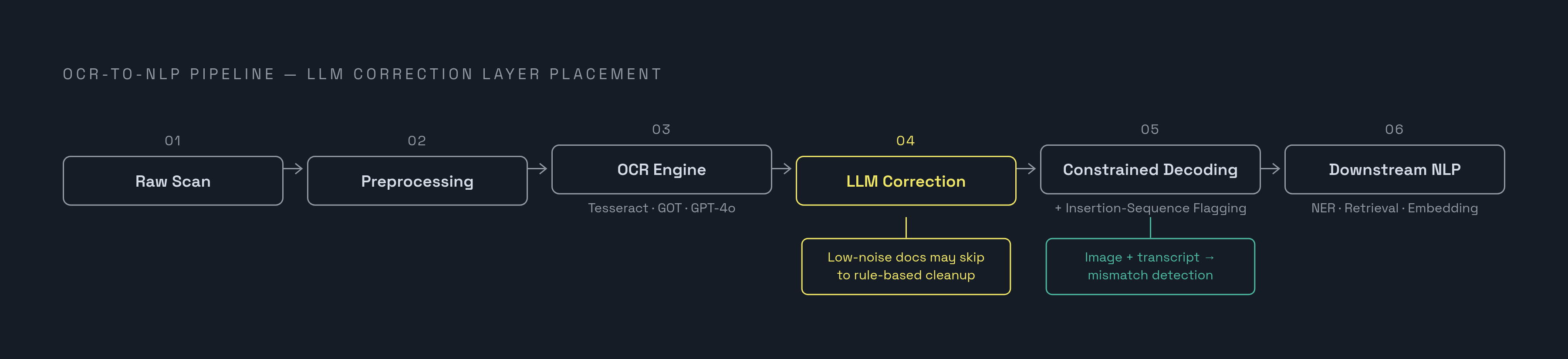
The standard flow looks like this: raw scan, preprocessing, an OCR engine (Tesseract, GOT, GPT-4o, whichever fits the job), a language-model correction layer, then downstream NLP tasks like NER, retrieval, or extraction. The correction layer belongs after OCR and strictly before any embedding or indexing step. A RAG system that ingests uncleaned OCR text doesn't just tolerate the noise; it propagates that noise into every single retrieval that follows, which is a slow, quiet way to make a whole system worse without any single obvious failure to point at.
Constrained decoding offers a structural guardrail worth building in directly: limit the model's output to edits within a defined edit distance, or restrict it to a fixed vocabulary, so an insertion hallucination physically cannot make it into the final transcript. Pair that with the insertion-sequence detection mentioned earlier, flagging long inserted strings for human review rather than accepting them automatically, and there's a real, working check on the model's tendency to invent.
Noise-level routing helps too. Measure the incoming document's CER before deciding whether to run it through the LLM layer at all. Low-noise documents may do just fine with lightweight rule-based cleanup, saving the LLM correction for the moderate-to-high noise cases where the gain actually outweighs the risk. Where source images are still available, the multimodal option changes the task itself, from "generate a guess" to "find the mismatch," which structurally reduces the pressure toward hallucination in the first place.
At scale, this becomes an engineering problem as much as a modeling one. Large document pipelines need parallel processing, tools like Ray for distributed frameworks or OCRmyPDF for batch work, per ScienceDirect research published in 2026. A microservice architecture that keeps the OCR layer and the correction layer independent, per an arXiv 2025 paper on the topic, means either one can be swapped or updated without redeploying the whole system. Some production platforms already build this in directly; LLMWhisperer's design, for instance, places OCR cleaning right before the embedding step, illustrating what the handoff into a RAG architecture is supposed to look like, with clean, structured text going into retrieval instead of raw scan output hoping for the best.
Synthetic training data: the practical path to fine-tuning when paired corpora don't exist
Circle back to the scarcity problem from earlier: paired noisy/clean corpora are rare for most document types, and brutally rare for historical, domain-specific, or non-English material. Synthetic corruption is the workaround, and it's more principled than it sounds. Since OCR errors follow identifiable patterns tied to character shape, scan artifacts, and font quirks, it's possible to take clean text and deliberately corrupt it in ways that mimic those patterns, generating training pairs without ever needing a real noisy scan.
The CLOCR-C heuristics, again from Bourne's 2025 IJDAR paper, are the most specific guidance published on how to do this well. Use non-uniform character-level Markov corruption rather than random uniform noise, since real OCR errors aren't evenly distributed. Aim for under-corrupted synthetic data; over-corrupting produces a training distribution that no longer resembles what real OCR output actually looks like, which defeats the purpose. And for a fixed token budget, prioritize longer context per example over a larger number of shorter examples.
There's a trap worth naming here too: model collapse. Training a model recursively on data generated by another model, meaning using LLM output to generate more synthetic training data in a loop, can degrade performance over successive generations. Avoiding feedback loops in the data pipeline isn't optional; it's the difference between a training set that improves and one that quietly rots.
ICDAR 2019 and ICDAR 2017 remain the standard benchmarks for English-language evaluation, while HIPE-OCRepair-2026 introduces multilingual evaluation at controlled noise levels, which better reflects the messiness of real-world degradation than a single clean benchmark ever could. The practical takeaway for anyone sitting on a pile of clean digital documents in a target domain: synthetic corruption is a workable path to fine-tuning without hunting for rare paired data. The bottleneck isn't data volume anymore. It's methodology.
Evaluation metrics that reflect pipeline goals, not just transcription fidelity
CER is the standard metric: the minimum number of character-level edits needed to turn the model's output into the reference text, normalized by the length of that reference. WER is the coarser cousin, measured in whole words rather than characters, and it matters because plenty of downstream NLP tasks care about word boundaries, not character-level nuance. Error Reduction Percentage (ERP) expresses relative improvement over some baseline, which is useful for comparison, provided everyone agrees on what that baseline actually is.
Normalization choices matter more than they get credit for. Lowercasing, stripping punctuation, trimming whitespace: each of these can shift a reported score meaningfully, which means comparing two systems' numbers is only valid if both used the same normalization rules. Skip that check, and the comparison is comparing apples to a fairly different-looking fruit.
HIPE-OCRepair-2026 leans on information-retrieval-oriented normalization, aiming for lexical recoverability and downstream usability rather than strict diplomatic fidelity to the original page. That's a deliberate choice, and it points at something worth sitting with: a pipeline feeding a search index should be judged on retrieval performance, not CER in isolation, while a pipeline serving archival scholarship needs a far stricter fidelity standard, one where over-correction counts as a genuine failure rather than a rounding error.
Hallucination-specific evaluation is still an open problem, and it's worth being honest about that rather than papering over it. There isn't yet a standard metric that cleanly separates a beneficial correction from an invented one. Insertion-sequence detection, from the FedCSIS 2025 work mentioned earlier, is a useful heuristic, not a formal benchmark, and treating it as more than that would be its own kind of overclaiming.
So the practical order of operations is: define the downstream task first, then pick or build the metric around it. CER alone won't tell a RAG pipeline whether its retrieval got better. It'll just tell someone that the text looks a little cleaner, which is a different claim entirely, and worth remembering the next time a report leads with a tidy accuracy number and nothing else.