Fixed-Size vs Semantic Chunking for Document Retrieval Accuracy
Fixed-size chunking outperforms semantic chunking on real-world benchmarks, despite its simplicity.
Retrieval quality depends on how documents become chunks before being embedded, and the results overturn what many teams assume about a RAG pipeline. Fixed-size chunking, both the plainest and cheapest option, beats semantic chunking for end-to-end answer accuracy across the largest benchmarks run. Semantic chunking shouldn't be the default in most live apps, and the benchmark results below confirm it: on end-to-end answer accuracy, fixed-size chunking beats semantic chunking across the largest benchmarks run. Teams reaching toward it up front are generally solving something they haven't confirmed exists.
What semantic chunking and fixed-size splitting do, stripped of the sales pitch
Fixed-size chunking is usually recursive text splitting. It works down a ranked list of split points, paragraph boundaries, then sentence ends, then word edges, then single letters, keeping the cut clean where it can. It uses no AI for this. It only counts and splits, so the chunks end up about the same size each run. Most setups run from 256 to 1,024 tokens and keep 10 to 20% overlap for neighboring chunks, so a sentence split still has context.
Semantic chunking starts from a different premise. It compares embedding similarity across neighboring lines, then marks where similarity drops and reads those drops as topic seams. The chunks that result each hold one thought, yet their size swings wildly between chunks, and they cost more time to make, because every sentence must have an embedding of its own before the splitter is able to spot the seams.
Here’s the dividing point: fixed-size can ignore the document’s meaning, but semantic chunking requires complete embedding work before any splitting. Different price, different pace, different failure pattern. Recent work on knowledge encoding (arXiv:2506.13778) explores ways to improve semantic breakpoints, sharpening the question: does a more sophisticated approach justify its cost in the pipeline that matters?
The benchmark result that should reframe the conversation: fixed-size wins end-to-end
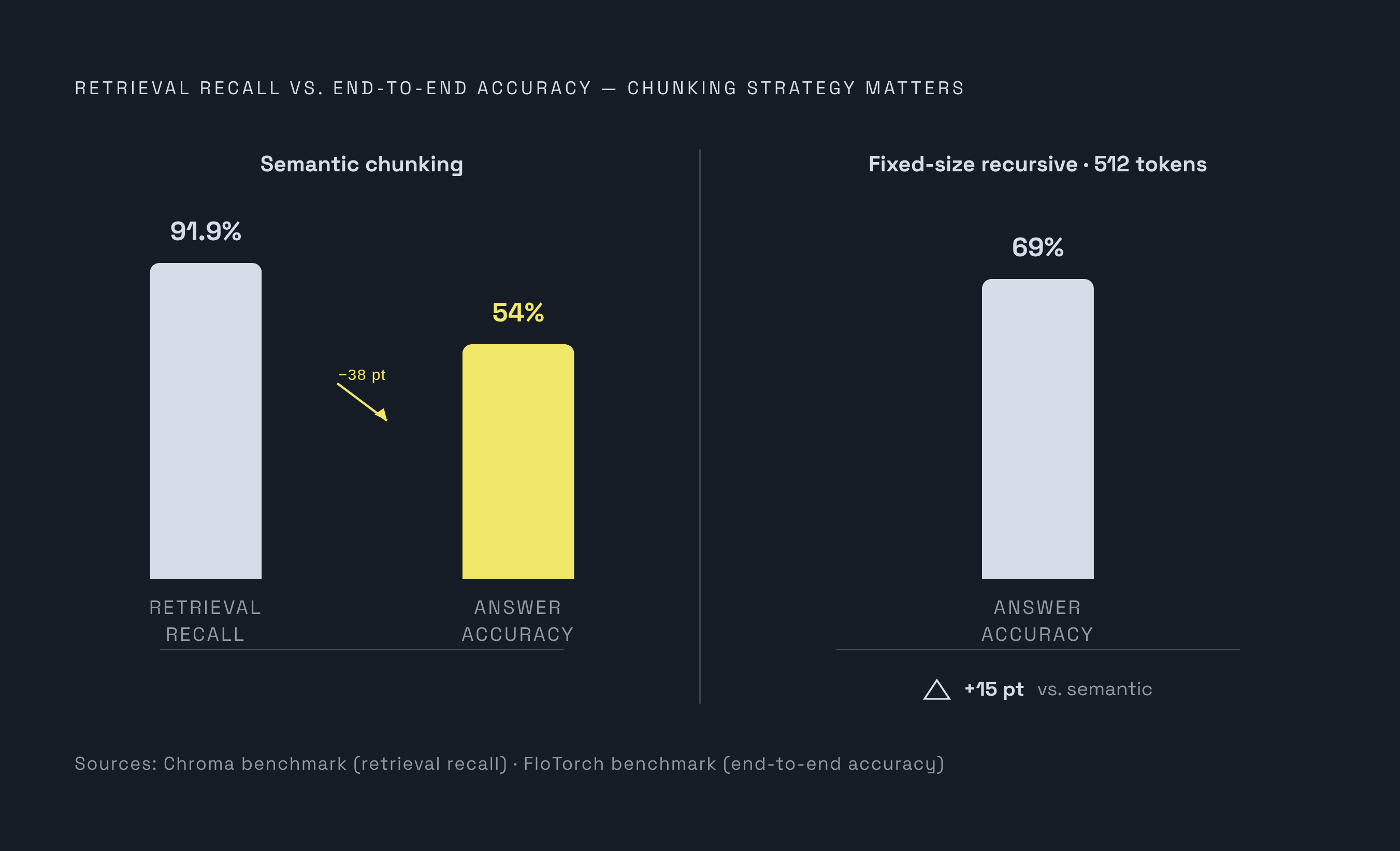
In Vecta's February 2026 benchmark run on 50 academic documents, recursive 512-token splitting hit 69% accuracy. Semantic chunking hit 54%. A 15-point margin put the dumber, cheaper approach ahead of its pricier counterpart, and it won.
Other benchmarks align with this finding: for document retrieval and answer generation, fixed-size chunking consistently outperformed semantic chunking. Additional studies from 2025 found that a simple 200-word chunk size matched or exceeded semantic chunking on real-world data. Further research in 2025 confirmed the same trend.
These results aren’t close. Most search groups think paying more for smarter, embedding-based chunking improves results, and Vecta's and FloTorch's benchmarks poke a hole in that: semantic chunking yielded fragments averaging just 43 tokens each. Fragments that narrow can still hit a query with precision, but they starve the LLM of the context needed to answer well. Locating the right passage and holding enough context to answer are two different tasks. That hinge drives everything else in this piece.
In that pipeline, Semantic chunking hit 91.9% recall with 54% accuracy.
Chroma checked one thing: how much of the right text the search pulled up. Semantic chunking took that benchmark outright, at 91.9%, ranking first in the evaluation.
FloTorch looked at a different question: did the LLM give the right answer with what the retriever supplied? Semantic chunking reached 54% on that metric, 15 points behind recursive splitting.
Those two figures mark two different failure spots in the same pipeline. Even a 43-token fragment might fit a query well because it stays topically narrow, yet give the LLM too little context to work out a right answer. Strong recall, bad answer: this is where semantic chunking breaks down once fragments shrink too much. Relying only on retrieval recall to evaluate a RAG system misses the point when production-grade answers matter more than tidy passage matches.
A systematic analysis placed the "context cliff" at roughly 2,500 tokens, after which quality drops. Chunk size needs both a floor and an upper limit, not just more or less. Benchmarking points to one straightforward move: set a minimum size floor for semantic splitters. Fragments below roughly 100 tokens usually don't have enough context for an answer, and enforcing the floor recovers a solid chunk of accuracy from over-fragmented splits.
The twist for clinical and legal document types
The fixed-size approach doesn't always come out ahead, and the gap is striking. In peer-reviewed clinical decision support work from MDPI Bioengineering, aligned adaptive chunking along logical topic boundaries reached 87% accuracy versus fixed-size baseline performance of 13%, confirmed statistically at 0.001.
That 74-point gap is tied to the domain: clinical decision support documents have an unusually rigid structure with a predictable logical flow, giving adaptive chunking something solid to align against. The same pattern generalizes wherever documents have strong inherent topic boundaries. In an enterprise healthcare knowledge base of over 2,000 documents, the Semantic Disentanglement Pipeline improved Top-K retrieval accuracy to about 82% from roughly 32% with fixed-token chunking (Loghmani, Salesforce/Syracuse, arXiv:2604.17677). One more field, one more sign of how wide that gap runs once document structure carries weight.
Chunking by set length breaks down here because of how it works. One clinical idea can run across multiple paragraphs; a legal clause needs the sentences around it; and headers hold semantic value that a token limit drops without noticing. Equal-length chunks remain the better broad fallback, but highly organized collections, medical guidance, law agreements, and many-part compliance reports, expose its costs clearly. The numbers back Routing documents by type, rather than crowning a single method for each corpus, as the synthesis.
How chunk size and overlap interact with query type
No hyperparameter in a RAG pipeline offers more leverage than Chunk size. Pick a size outside the working range and context precision drops, which NVIDIA has actually measured instead of guessing.
The 2026 benchmark points to broad size brackets by use case: question-answering with documentation fits 200 to 400 tokens, summarization calls for 800 to 1,200, and finding functions takes 50 to 150. NVIDIA broke them down by type: short factual prompts work well at 256 to 512 token sizes, but complex reasoning steps do better with chunks of 1,024-token or full-page chunking.
Overlap carries useful information across chunk borders, but there's a cost to pushing it higher. Oversized segments drive up disk and vector expenses, while feeding the LLM repeated text that crowds out useful information. NVIDIA reported 15% overlap worked best for bigger chunks in FinanceBench. Some enterprise setups use 512-token chunks with 25% overlap, often measured by BERT tokens rather than raw characters. Arize AI, testing retrieval-depth, showed chunks of 300 to 500 tokens paired alongside K=4 retrieval struck the clearest trade-off between quickness and answer quality: tuned chunk size without retrieval tells only part of the story.
One systematic review pushed the point by benchmarking 36 segmentation approaches in six subject domains using five different embedding setups. Paragraph Group Chunking ranked first, averaging nDCG at 5 near 59%, confirming content-based chunking outperforms simple fixed-size chunking in wide trials.
What fixed-size baseline leaves out
Most teams running real systems have converged on Hierarchical chunking as their pattern. It runs tight chunks to spot the right passage and big container chunks so the system has something to actually work through, sidestepping the trade-off between precision and context rather than picking one of the two.
An AI vendor's benchmarks and late-chunking research show that Contextual retrieval, which prepends a model-written context note ahead of embedding each chunk, paired with chunking (embedding an entire document using a long-context setup, then pooling token vectors into chunks afterward), cuts retrieval failure by 35 to 67% compared against plain fixed-size chunking. The spread is large, but even the lower figure gives a real gain with almost no extra architectural burden.
Microsoft's Azure Architecture Center testing (2025) showed Metadata enrichment, adding structured context to chunks without changing the split, pushed QA accuracy up from about 50 or 60% to 72 to 75%. It’s among the highest-return moves on offer, with no rework needed. IPN/CIC (arXiv:2506.13778) pushed question-based encoding ahead, hitting 0.84 for Recall@3 on 109 scientific research articles, a 60% gain over standard chunking, while "paper-card" summaries raised MRR@3 to 0.85 from 0.56 on simplified queries. That method also removes the fine-tuning step and shrinks vector storage by 80%. It remains an early-stage choice, not yet a drop-in fix.
Most teams pick their chunking method based on the document format: PDFs get split by page, HTML uses simple breaks, and source files rely on language structure instead of counting words. Document type picks the approach; no one-size-fits-all configuration works across all of them. The January 2026 systematic review found that simple chunking kept pace with semantic chunking on documents up to around 5,000 tokens, while running on far less compute. A practical compromise for teams that need more than plain fixed-size while avoiding full semantic overhead.
A decision framework for choosing the right chunking approach for a given system
Begin with the 512-token recursive approach, keeping overlap at 10 to 20%. Recent benchmarks show that a 512-token recursive approach avoids LLM overhead and still leads in broad comparisons. Reaching for semantic chunking means solving an issue they haven't confirmed exists.
Stick with the default unless the data shows a clear need. When documents already carry clear logical structure, clinical guidelines, legal contracts, regulatory filings, adaptive or semantic chunking matched to topic boundaries is what the evidence supports, since the accuracy gap can stretch into the tens and remains statistically meaningful. A corpus of document types needs routing by type rather than one shared default, as PDFs and web pages, plus code, each need a different splitter. Multi-step queries benefit from larger chunks and layered retrieval to ensure the LLM has enough context. For precision, factoid lookup queries need tighter chunks between 256 to 512. Wherever semantic chunking is the approach, a minimum size floor can't be skipped. Very small fragments often reduce answer quality, even when retrieval recall remains high.
Test the whole pipeline, not just search hit rates. Chroma and FloTorch’s 91.9% versus 54% split offers the clearest illustration of how a bad metric can make a broken pipeline seem reliable. Skip the heavier architectural overhaul and pull metadata enrichment forward: accuracy moves from roughly 50–60% into the 72–75% range (Microsoft Azure Architecture Center, 2025) without altering the chunking approach. Embedding MTEB benchmarks won’t show how it performs on your domain’s content, which makes testing against your own corpus essential before locking in a configuration.
Chunking decisions should be revisited against real outcomes rather than left as one-time choices. Data indicates that 90% of teams running RAG in production lack a systematic way to evaluate retrieval quality, often overlooking chunking as a potential failure point.
Chunking strategy matters for brands working with AI-powered search.
Most AI tools rely on RAG behind the scenes, taking select parts from sites and passing them to an LLM as input before it produces a reply. How content gets chunked shapes if an AI system shows it to someone, and that turns a backend decision into a visibility issue teams have to handle.
The user base at the pipeline's output has grown too large to ignore. OpenAI says ChatGPT hit 900 million people per week, up from 400 million twelve months ago. BrightEdge says AI Overviews appear in tracked queries at roughly 48%, up 58% year-over-year. A standard Google search lists ten items, yet an AI answer may cite two or maybe three references, and this hyper-selectivity turns retrieval precision into something teams can't just fix behind the scenes.
Data on AI visibility gaps shows the difference between leading and lagging brands is now about 9x and growing at 3.2% monthly. Only 16% of brands systematically monitor how they show up in AI results. A Princeton and Allen Institute for AI study showed optimization can raise a source's visibility by as much as 40% in AI-generated answers (Aggarwal, KDD 2024), while structured, well-chunked pages use roughly 200 to 300-word topical blocks, headers, facts phrased for citations, and copy that answer specific queries rather than bury them.
A 2026 survey found nearly half of teams are now optimizing content for AI-driven discovery. Teams handling many brands can't run a portfolio on a fixed-size default for wildly different document types and avoid retrieval failures. Once a portfolio reaches enough scale, document-type routing shifts from optional to required, and chunking belongs squarely at the front of that process. Tracking whether material surfaces inside AI answers across a whole portfolio is how chunking decisions are ultimately measured.
Sources
- RAG Chunking Strategies & Embeddings Optimization: The 2026 Benchmark Guide
- RAG Chunking Strategies: The 2026 Benchmark Guide
- arxiv.org
- arxiv.org
- Chunking Methods on Retrieval-Augmented Generation – Effectiveness Evaluation Against Computational Cost and Limitations
- trychroma.com
- A Systematic Investigation of Document Chunking Strategies and Embedding Sensitivity