Binarization Algorithm Tradeoffs for Low-Contrast Document Scans
Different degradation patterns demand different algorithms, with no universal solution.

Binarizing low-contrast documents means balancing the retention of faint characters against the removal of spurious artifacts. No single algorithm is equally good at handling uneven illumination, noise, fading, or bleed-through. Thus, selection should be guided by how the page has deteriorated rather than a method's standing, while also weighing if converting to black and white truly benefits subsequent OCR.
Why binarization is the decision that shapes everything downstream
Its pixel values must be interpreted first, only then can the characters be picked out. Unlike something typed up with word-processing software, a scan never begins as text a computer can read. Binarization puts every pixel on one side or the other, foreground or background, and the binary image that results cannot undo that hard call. Text assigned to background is gone as far as OCR is concerned in that image, and noise assigned to foreground ends up feeding the recognizer. Because those errors work their way into extracting text and into indexing archives, the decision matters.
The degradation patterns that make low-contrast scans genuinely difficult
Low contrast can come from several different things. Uneven illumination makes some parts of the page lighter or darker than others, preventing a single threshold from reliably telling text from paper. With ink bleed-through, marks showing through from the reverse side add dark speckling that can be mistaken for foreground text. Faded ink and hairline strokes pose the reverse issue, leaving the text signal too weak to separate cleanly from the background.
Other damage makes it harder to tell text from paper. Paper marks like foxing, smears, and stains alter the backdrop locally, while digitization introduces white noise alongside normally distributed and impulse artifacts. An old document could show bleed-through alongside faded ink and stains on a single sheet. Approaches that set one cutoff across the entire picture contrast with those calculating limits per region or pixel. That choice is the first split when picking an algorithm, but local adaptation alone cannot isolate faint lettering from all forms of degradation.
What Otsu's method does well and where it stops working
Otsu’s method serves as a reference point for evaluating competing approaches, since the threshold is picked automatically and demands minimal computation. Otsu’s method examines the image histogram, selecting a cutoff that maximizes foreground-background separation while minimizing variance within each class. The method presumes the histogram takes a two-peaked, well-separated form. Because clean scans have uniform backgrounds, this assumption holds and Otsu is both suitable and a simple default. The key factor is how pixel intensities are spread, irrespective of the document's age.
When lighting is uneven, the image no longer matches the model, since background intensity varies from place to place. The cutoff may instead leave letters fragmented, fuse neighboring ones, or mark broad noisy patches. Bleed-through creates a different mismatch by adding another intensity cluster outside the normal text-and-paper pattern. Even so, the study by Gupta et al. reported that Otsu remained a valid premise for printed historical documents in many historical newspapers.
How Niblack and Sauvola respond to the problems Otsu cannot handle
Rather than applying a single global limit, Niblack derives an individual threshold for every pixel. By computing average and variance values within a moving neighborhood, the cutoff adapts to regional illumination shifts across the document. But relying on those local statistics creates problems wherever the backdrop lacks variation. There, dispersion metrics may elevate random fluctuations to foreground status, leaving marks where no text exists.
Sauvola strengthens this method by scaling local thresholds against the variation in nearby pixel values. This limits spurious responses where contrast is weak while preserving sensitivity to real foreground detail. Thus, the method evolves from simple adaptation toward better suppression of background noise. The usual Sauvola method only partly addresses the issue, because very low contrast and contrast inversion can still cause failures, so dark-backed pale text or graphics, as in magazine content, may be missed.
The NICK algorithm's specific target: antique documents with pale regions
NICK is built to pick up text that gets lost where aging has faded the print on old manuscripts. By dropping the binarization cutoff below what Niblack computes in pale zones, it salvages characters that the older method treats as part of the page. This suits degraded historical documents bearing faint lettering or discolored sheets, yet it cannot universally resolve poor contrast. Bataineh argues that NICK fails to beat Niblack in severe cases, such as when global contrast is minimal, letter dimensions fluctuate, or delicate glyphs lack distinction. Faint strokes and barely visible lettering still require manual adjustment of the k parameter, shrinking the advantage precisely when calibration is hardest.
Why window size and k-parameter tuning are the practical bottleneck for local methods
The Sauvola-family’s output is shaped by two closely linked settings, k and window size. Window size determines which surrounding pixels feed the local-statistics calculation, while k tunes how strongly sensitivity is weighted. An undersized window may leave strokes fragmented or hollow, since it samples too narrow a range of intensities. An oversized window can make characters appear heavy or fused by blending information over too broad a region and setting the local threshold too high.
A practitioner first runs into the practical difficulty after finishing a newspaper set from the 19th century and then receiving handwritten ledgers. A configuration tuned on newspapers cannot be reused unchanged with handwritten ledgers. Retuning the configuration calls for advance familiarity with the incoming documents, without settled defaults to avoid that task. In standard Sauvola, the window stays constant despite variations in the image, forcing the practitioner to weigh local intensity against stroke characteristics and noise. As a result, day-to-day use is limited less by runtime than by the labor of finding dependable parameters for every collection.
Automated parameter estimation as the path out of manual tuning
Modified Sauvola cuts down that work by pulling the window size straight from the image. It runs SWT to figure out how wide the text strokes are locally, then changes the neighborhood for every single pixel. A neural approach called SauvolaNet tackles the same issue with an attention mechanism that predicts what window size each pixel needs. That lets it compute Sauvola's threshold with no manual tuning, which shows classical thresholding can serve as the foundation for learned adaptation.
Other extensions refine window characterization and computational cost. Ren and colleagues’ 2022 side-window scheme uses multidimensional convolution to capture pixel morphology and spatial arrangement. As a result, it is more robust when images are noisy, degraded, or unevenly lit. Chan’s 2019 study recasts Sauvola-family thresholding recursively, achieving linear-time execution for any window size with much lower auxiliary-memory needs than integral-image schemes. Together, these advances target separate challenges such as choosing parameters, handling noise, and limiting resource use, instead of leaving classical methods stuck with their original limits.
What deep learning and ML-based frameworks offer and where they fall short
When multiple types of degradation hit a page at once, Deep learning and ML-based frameworks offer a real option. They handle overlapping noise, ink seepage, and patchy lighting better than techniques built for a single flaw. DIBCO, the Document Image Binarization Competition running since 2009, functions as the standard benchmark for evaluating such efforts. According to the 2024 DIBCO report, modern neural techniques consistently beat traditional algorithms on this test. Those results prove their worth on hard material, but they are not the best pick for every collection.
Model-based approaches depend on examples, processing resources, and source pages close to the training domain. They become less reliable when new inputs fall outside what they were trained on. The separate 2024 Competition for Binarizing Photographed Document Images judged output quality, runtime, storage cost, and how well images were binarized. When collection damage remains within what a quick traditional algorithm can manage, it can be the wiser option over a high F-Measure score requiring GPU inference at scale.
The debate over whether binarization always helps OCR accuracy
Even the best binarization method does not always beat retaining grayscale for OCR. Converting to black and white strips away tonal cues that OCR systems occasionally rely on when deciphering unclear characters. When faint text sits close to a cutoff point, hard thresholds push it entirely into the page or the lettering, yet keeping continuous tones lets smart software handle the ambiguity. With these documents, bypassing or postponering the threshold step often yields superior OCR accuracy.
Martínek and colleagues found that binarized images helped more than grayscale when processing a German newspaper from the 19th century. Holley, however, found that bi-tonal and greyscale files yielded comparable OCR accuracy. These results show that downstream recognition quality is distinct from how clean the binary page appears. Therefore, choosing whether to binarize should be considered alongside selecting the algorithm.
How hybrid approaches and confidence-based routing handle mixed-degradation collections
Modern archival workflows often combine contrast enhancement and adaptive thresholding, then sort pages according to predicted difficulty. By correcting weak contrast, shadows, and uneven exposure ahead of thresholding, enhancement improves the source image instead of attempting a later fix once tonal detail is gone. Confidence scoring keeps cleaner pages on a quick classical path, while routing harder ones to heavier processing. Work is therefore spent where pages require it, rather than making every item pay for the most demanding case.
In Correia and Luck’s account, source images first undergo de-warping and contrast adjustment ahead of OCR, after which the extracted data is validated against established relationships. Here, binarization remains one adjustable option within preprocessing. The workflow may still link preparation with method choice and later checks while allowing pages to be handled differently.
A decision framework for matching algorithm to degradation type
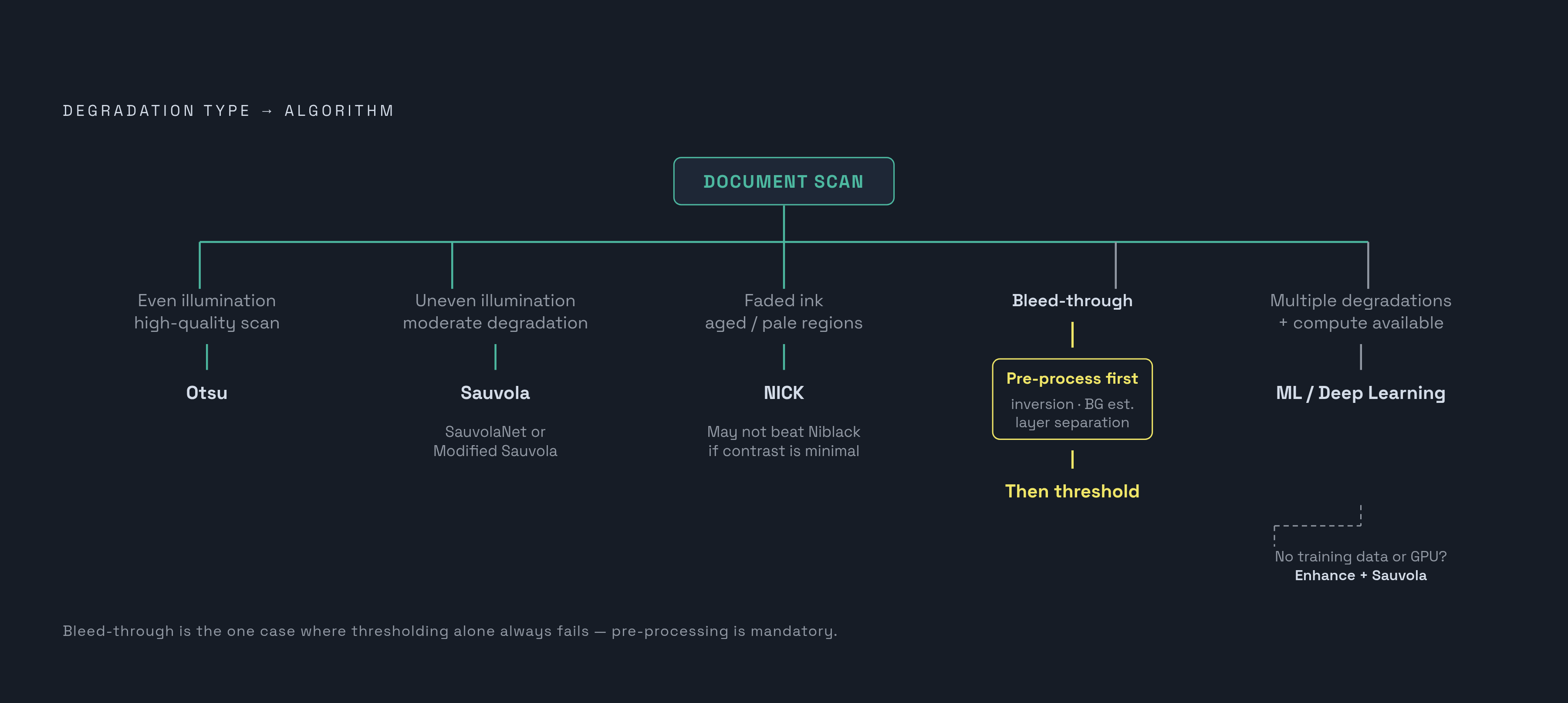
Selection starts with the main degradation in the document set. When working from high-quality scans where illumination stays even, Otsu is computationally cheap, as long as the histogram is bimodal. When illumination shifts, backgrounds drift gradually, or degradation is moderate, Sauvola or another Sauvola-family method works better. Each collection needs dedicated effort to adjust parameters, though SauvolaNet or Modified Sauvola might eliminate that burden. For aged documents showing faded areas, NICK deserves consideration, yet delicate letterforms or minimal global tonal difference may nullify its edge against Niblack.
Bleed-through requires handling apart from thresholding, since global and standard local methods both falter when used alone. A steadier workflow first cleans the page with contrast inversion, estimates the background, or separates layers, then applies thresholding. When faded ink and staining coincide with bleed-through, ML-based systems, including deep learning, are suitable provided the document type has matching training data and enough compute are available. If not, after contrast enhancement, Sauvola can bridge the gap, and strong OCR may work better on grayscale input.
Production limits finish the decision. When constraints on processing rate, storage capacity, or GPU access govern deployment, classical local methods built recursively stay viable at scale. Since DIBCO results combine performance across datasets, a method ranked lower can beat the top-ranked one on a specific collection's unique degradation. Thus testing on a subset mirroring the target materials must happen prior to finalizing any pipeline setup.
Notes
- Digitizing Historical Balance Sheet Data: A Practitioner's Guide
Provided the example of de-warping and contrast adjustment preceding OCR, with extracted data validated against established relationships, cited as Correia and Luck's account.
- Memory-efficient and fast implementation of local adaptive binarization methods
Provided the basis for describing Chan's 2019 recursive Sauvola-family thresholding that achieves linear-time execution with lower memory needs than integral-image schemes.
- Binarization Algorithm Based on Side Window Multidimensional Convolution Classification
Provided the basis for describing Ren and colleagues' 2022 side-window multidimensional convolution scheme for handling noisy, degraded, or unevenly lit images.
- A Review of Document Binarization: Main Techniques, New Challenges, and Trends
Provided the 2024 DIBCO report findings that modern neural techniques consistently beat traditional algorithms, and context on the Document Image Binarization Competition running since 2009.
Every new piece from The Parse Layer, as it's published.
Follow