Metadata Filtering Strategies in Production RAG Pipelines
Metadata filtering prevents retrieval failures that confident language models won't catch.

Metadata filtering is what separates a RAG demo from a system that survives contact with real users⟦c2⟧. By narrowing the candidate set on tenant, date, access level, and content type before semantic search even runs, engineers get a kind of control that similarity scores alone can't offer⟦c2⟧. Metadata Filtering Strategies in Production RAG Pipelines ⟦c1⟧.
Why semantic similarity alone breaks in production
It works cleanly in a demo, where the corpus is small and every document is fair game for every question.
Production is a different animal. Vector search doesn't know about time, ownership, or who's allowed to see what. It only knows meaning, and meaning is exactly the thing that's insufficient here.
That gap has a name: context poisoning. The retriever hands the model documents that read as plausible but are factually beside the point, and the model, having no way to know it's been misled, writes back a confident answer anyway⟦c4⟧. Nobody flags it as wrong at generation time, because nothing about the output looks wrong. It's fluent, it's structured like a good answer, and it's grounded in the wrong source entirely⟦c5⟧.
The scale of this is not a rounding error. Naive RAG pipelines fail at retrieval roughly 40% of the time, with the model producing a well-formed, confident answer sourced from documents that shouldn't have been in the candidate set to begin with⟦c5⟧. Separately, GPT-3.5 hallucinates on around 39.6% of systematic research tasks and GPT-4 on around 28.6%; layering RAG on top cuts those rates by 70 to 90%, but only when the retrieval step actually pulls the right documents⟦c6⟧. Without correct retrieval, the RAG layer stops helping ⟦c2⟧. The bottleneck in 2026 production deployments is squarely at retrieval, not generation⟦c7⟧.
This is a concern that matters right now. That's a lot of companies now depending on retrieval doing its job correctly, every time, without a human checking each answer. The basic RAG promise follows a chain from query to embedding to nearest neighbors to grounded answer ⟦c3⟧. 72% of enterprises run RAG in production as of Q1 2026, up from just 8% in Q1 2024, and the stakes of getting retrieval right have never been higher ⟦c8⟧.
Metadata filtering's place in the retrieval stack
Metadata filtering means applying structured constraints, department, date range, security tier, on the candidate set, either narrowing it before the nearest-neighbor search runs or trimming it after. It answers a different question than similarity search does. Metadata filtering asks whether a document is even allowed to be in the running for this particular query, regardless of how well it matches semantically.
The 2026 retrieval stack usually stacks several of these mechanisms on top of each other⟦c9⟧. Dense retrieval, the cosine-similarity-on-embeddings approach, catches paraphrase and conceptual overlap. Sparse retrieval, BM25 or its newer variant BM42, catches exact terms: product codes, named entities, the kind of token match dense embeddings tend to blur ⟦c10⟧. Metadata filters then sit on top of, or ahead of, all of that, enforcing the tenant, date, and access boundaries the business actually cares about. A reranker takes whatever survives and does the final ordering.
Filtering is the control layer here. It's the control layer, the part of the stack that decides whether the system is trustworthy enough to put in front of paying customers. And none of it works unless the right metadata was captured back when the documents were first ingested. Reciprocal Rank Fusion (RRF) is the dominant method for combining dense and sparse ranked lists ⟦c11⟧.
Designing a metadata schema for real retrieval workloads
Every field a team wants to filter on at query time has to be stored, explicitly, alongside each chunk when it's ingested. There's no retrofitting this later without reprocessing the whole corpus.
A workable schema tends to cover a handful of distinct dimensions. Content identifiers, document ID, chunk ID, chunk index, and a pointer to the parent chunk, support hierarchical retrieval and let the system cite its sources properly⟦c12⟧. Access control fields, department, a security level tier (public, internal, confidential), allowed roles, and an allowed_principals list pulled straight from the source system's user and group IDs, are what make row-level security enforceable rather than aspirational⟦c13⟧. Content classification fields, type (policy, procedure, FAQ, tutorial), product version, language, let a query narrow itself to the right kind of document before similarity even gets computed⟦c14⟧.
Enriching each chunk with a generated title, extracted keywords, and a handful of hypothetical questions it could answer, then prepending that to the chunk text before it gets embedded, is a technique that stands apart from the raw fields. This nudges the embedding itself toward the kind of complex queries users actually ask, and gives the LLM more to grab onto when it interprets what it's been handed⟦c15⟧.
None of this happens by hand at scale. Apache Tika and Unstructured.io are both practical, open-source options for turning PDFs, HTML, DOCX, and PPTX files into clean, consistent text ahead of metadata extraction, and tools like Docling, LlamaParse, and Marker show up often in AI and RAG pipelines for the same reason⟦c16⟧. Changing that decision later means re-embedding the entire corpus from scratch, so getting it right the first time matters more than patching it after launch⟦c17⟧. Manual metadata tagging doesn't survive contact with any corpus of real size either; inconsistency appears in the tagging process, and inconsistent metadata breaks filters downstream in ways that are hard to trace back to their source.
Pre-filtering versus post-filtering: the architectural tradeoff that determines performance
Once the schema exists, the next decision is when the filter actually runs relative to the vector search. Pre-filtering applies the constraint before the approximate nearest-neighbor search starts, so similarity search only ever looks inside the eligible subset⟦c18⟧. Done well, this is both faster and more precise, though it depends on the database actually supporting filtering natively rather than bolting it on as an afterthought.
Qdrant is a good illustration of what pre-filtering done properly looks like. Weaviate takes a related but distinct approach: an inverted index produces an allow-list of eligible object IDs first, the HNSW search then runs constrained to that allow-list, and roaring bitmaps keep the matching fast even as the allow-list shrinks or grows⟦c20⟧.
Post-filtering works the other way around: fetch the top-k results by similarity first, then throw out whatever doesn't match the filter afterward. It's simpler to build, and it's wasteful in a way that compounds. At 1% filter selectivity, returning just 10 usable results means retrieving something like 1,000 candidates up front and discarding 990 of them, which drags on both latency and the size of what's left to work with⟦c21⟧. The workaround, just requesting a bigger k, only pushes the cost elsewhere: more compute per query, and a noisier candidate pool for whatever reranker runs next.
This isn't a theoretical concern at scale. Reddit's deployment, running across hundreds of millions of vectors, found the vector search itself was fast; the metadata filter was the actual bottleneck⟦c22⟧. Most public vector database benchmarks test simple approximate nearest-neighbor search with no filters attached at all, and performance on a lot of these systems drops sharply the moment a complex, multi-field filter gets added⟦c23⟧. Metadata filtering is, by a fair amount of industry consensus, the hardest part of running vector search in production⟦c23⟧. Qdrant's payload-indexed HNSW applies the filter during graph traversal, not after, and at 10 million vectors with 1% matching the filter, it returns 10 results in 4 to 8ms ⟦c19⟧.
What the evidence shows about the precision gains from filtering
The numbers driving this are not subtle. One benchmark cited by Redis found metadata filtering raised system accuracy from 0.12 to 0.61⟦c24⟧, which is not a marginal tuning gain, it's a different system.
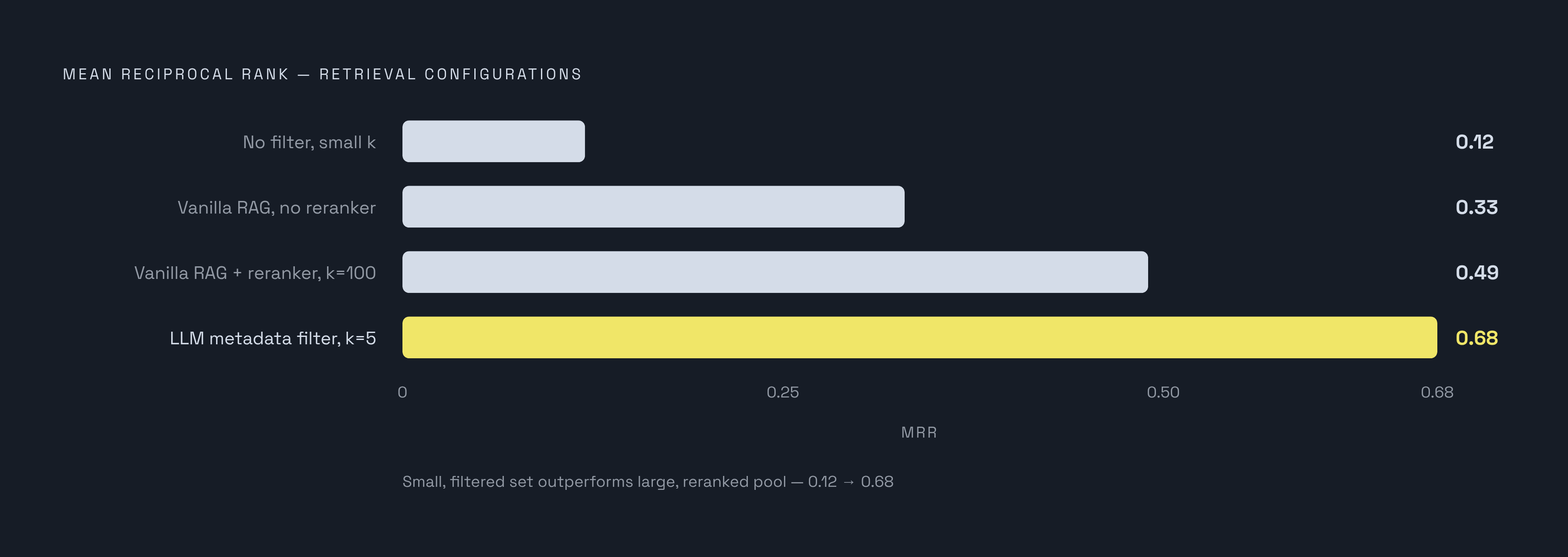
A vanilla RAG retriever tops out around an MRR of roughly 0.33 without a reranker, and 0.49 with one, even at k=100⟦c26⟧. Adding an LLM-generated metadata filter and evaluating at just k=5 raises MRR from around 0.12 to 0.68, more than a fourfold improvement⟦c27⟧. A small, tightly filtered candidate set beats a large, unfiltered one, even when the unfiltered one gets the benefit of a reranker on top. Filtering is doing its own distinct work here. It's doing something reranking can't, which is keeping irrelevant documents out of consideration in the first place.
Databricks' own guidance on retrieval quality lands on a similar sequencing: build an evaluation framework first, then layer in hybrid search, then metadata filtering, then reranking, treating each as a progressively more expensive step⟦c28⟧. Filtering earns its place ahead of reranking, not after it, because there's no point reranking documents that should never have been retrieved to begin with⟦c28⟧.
For teams trying to set a bar, faithfulness scores above 0.85 and context precision above 0.75 are the thresholds generally used for customer-facing deployments, and those numbers are difficult to hit reliably without filtering doing real work upstream⟦c29⟧. MRR evidence from arxiv 2505.13557 bears out these gains ⟦c25⟧.
How the main vector databases handle metadata filtering in practice
The vector database market was valued at around 1.8 billion euros in 2024, growing at over 25% annually, and by December 2025 it had consolidated around Pinecone, Weaviate, Milvus, and Qdrant⟦c30⟧.
Weaviate builds its pre-filtering on an inverted index plus roaring bitmaps, with range-oriented execution for fields like price or date, and layers hybrid search (vector plus BM25 plus metadata) on top of that⟦c10⟧. Its native multi-tenancy goes further than most: tenant data is physically isolated at the shard level, each shard running its own dedicated vector index, rather than relying on namespace-style filters alone⟦c32⟧.
Pinecone runs as a zero-ops managed service, supporting up to 40KB of metadata per vector, which is enough headroom for genuinely rich filtering without needing a separate metadata store bolted on the side⟦c33⟧. It bundles built-in inference (embeddings and reranking), full-text hybrid search with both alpha-weighted and RRF-based fusion, and BYOC deployment options; a paper on its serverless metadata-filtering architecture was presented at the VecDB@ICML2025 workshop in Vancouver in July 2025⟦c33⟧. The tradeoffs are cold-start latency on serverless pods and a higher cost per query at extreme volume, but for teams that don't want to run infrastructure at all, it's built for exactly that.
It costs nothing extra for teams already on PostgreSQL and is best for organizations under a few million vectors with existing PostgreSQL infrastructure⟦c34⟧.
Raw vector count is rarely what breaks a system. Filter complexity and selectivity are the variables that matter, and a database that's fast at plain ANN search can still fall apart under a compound, multi-field filter⟦c35⟧. Qdrant is Rust-based, with payload-indexed HNSW that applies the filter during graph traversal, handles high-cardinality metadata with minimal latency impact, achieves 4 to 8ms at 10M vectors with 1% selectivity, and is best for latency-critical workloads with complex metadata requirements and self-hosted deployments ⟦c31⟧.
Multi-tenancy and access control as the highest-stakes filtering scenario
Nowhere does a filtering mistake cost more than in a multi-tenant deployment. In a shared vector index, a filter that fails doesn't just return a bad answer, it leaks one customer's documents into another customer's result set, potentially exposing confidential material at the chunk level with no visible sign anything went wrong.
The underlying data hygiene problem is already widespread: Proofpoint's 2025 Data Security Landscape report found 46% of organizations struggle with cloud and SaaS data sprawl, and that sprawl turns into visibility gaps and compliance risk the moment it feeds into an AI system⟦c36⟧.
Three isolation models tend to come up for multi-tenant RAG⟦c37⟧. Silo isolation, a separate index per tenant, offers the strongest guarantees and fits enterprise customers who need it. Pool isolation, a shared index with metadata filters doing the separating, is cheaper to run and works for SMB customers where the stakes are lower⟦c38⟧. Bridge, a hybrid of the two, tends to suit a mixed customer base that spans both ends of that spectrum⟦c39⟧.
Whichever model gets chosen, the ingestion step has to attach an allowed_principals field to every single chunk, listing the user and group IDs pulled from the source system⟦c40⟧. Enforcement belongs at the infrastructure level. It cannot live in application code, and it certainly cannot live in the LLM's behavior, because an LLM can be prompted around and application code can have bugs, but an infrastructure-level filter either runs or it doesn't ⟦c4⟧.
Never rely solely on query-time filters for a security boundary. Isolation needs to happen at both the collection layer and the query layer, so that a failure at one doesn't collapse the whole guarantee⟦c41⟧. Weaviate's physical, shard-level isolation follows the same logic, and it's the architecture generally recommended for B2B SaaS platforms serving multiple law firms, financial firms, or real estate brokerages off shared infrastructure⟦c42⟧.
None of these isolation models mean much, though, if the system can't figure out which filter to apply for a given question in the first place⟦c43⟧.
LLM-driven filter generation: translating natural language queries into structured constraints
Users don't write filters. They write questions, in plain language, and the system has to infer the structured constraint hiding inside the sentence before retrieval even starts.
The self-querying pattern handles this by inserting an LLM step between the raw query and the retriever ⟦c4⟧. A question like "only Q3 2025 documents from the legal department" gets translated into something like {department: "legal", created_at: {gte: "2025-07-01", lte: "2025-09-30"}} before the vector search ever runs⟦c44⟧. The retriever never sees the natural-language query directly; it sees the structured filter the LLM extracted from it ⟦c4⟧.
This sits alongside a broader family of query transformation techniques⟦c45⟧. Query rewriting has the LLM rephrase the question, adding domain-specific vocabulary while keeping the original intent intact⟦c46⟧. Query augmentation adds context to a query that's too short or ambiguous to retrieve well on its own, and query decomposition splits a complex, multi-part question into sub-queries that each get retrieved separately before being reassembled.
The payoff for getting this right is the same fourfold jump cited earlier: LLM-generated filters evaluated at k=5 produce an MRR around 0.68, against roughly 0.12 for vanilla RAG⟦c47⟧. That gap doesn't come from the filter mechanism alone. It comes from the filter generation step correctly reading what the user actually meant, and that's the part responsible for the lift rather than the filter alone⟦c47⟧.
Sources
- How to Build a Production RAG System with Metadata Filtering | Reintech media
- How to Build a Production-Ready RAG Pipeline in 2026
- Metadata for RAG: Improve Contextual Retrieval | Unstructured
- Metadata Filtering: Boost Vector Search Precision at Scale
- Metadata-Driven Retrieval-Augmented Generation for Financial Question Answering
- AMAQA: A Metadata-based QA Dataset for RAG Systems
- Filtering in Vector Search with Metadata and RAG Pipelines
- RAG Metadata Filtering: Four Strategies for Production