HIPAA-Compliant Document Ingestion Pipelines for Clinical NLP
Securing clinical data at ingestion prevents HIPAA violations later.

Clinical NLP pipelines fail when PHI controls are postponed until information is already inside the system, instead of as a constraint the system must satisfy as soon as data comes in. This timing mistake, about where privacy rules first apply, can make an otherwise strong pilot a regulatory risk.
Why clinical NLP pipelines fail before reaching a model
Doctors spend part of every visit digging through old notes split among platforms never designed to exchange information. Teams feel the pressure to automate, and it drives them to cut corners. Over 80% of vital medical information lives as unstructured text within doctors' progress documentation, recorded visit transcripts, patient intake forms, and prescription faxes sent as PDFs. Because of this, ingestion becomes the first place PHI enters the pipeline and the riskiest step in the whole setup, since each of those formats hides identifying information inside language a machine must parse to extract any value.
The same pattern shows up across the industry. The model starts out in a tidy research dataset. The genomics database and EHR are treated as separate endpoints, with a pipeline built to link them. During testing, the connection usually holds up because the data is orderly. But once live patient records run through it, the setup breaks down because no one built the handoff to manage real PHI at the scale and messiness of a production clinical setting.
When a team skips rule-based de-identification of PHI and feeds raw clinical notes straight into general-purpose vector stores or openly hosted AI APIs, they break HIPAA the second such information passes the ingestion boundary. The violation doesn't wait for inference or an audit. The breach occurs the moment data crosses into the platform. And the responsibility doesn't end when a model hands back an answer. Any retraining cycle or model adjustment involving unmasked records bears an identical compliance burden to real-time inference. That means teams must architect the intake layer from the start around the full path those records will take, not just their first stop.
The common first build uses an overnight ETL batch to load clinical records in a relational database, which worsens the issue. Since updates wait for the nightly run, the clinical view is stale: if a prescription is added during a telehealth appointment after lunch, the record stays hidden until morning, and a same-day acute drug interaction or renal abnormality may be missing at the moment the clinician prescribes. That turns a compliance failure into a patient safety failure too. For a system to be credibly clinical, each recommendation must have an audit trail tying it to the exact patient record used, the approved model release, and the logged inference that produced it. Otherwise, the result is only a research prototype with a clinical interface.
What HIPAA requires at the ingestion boundary
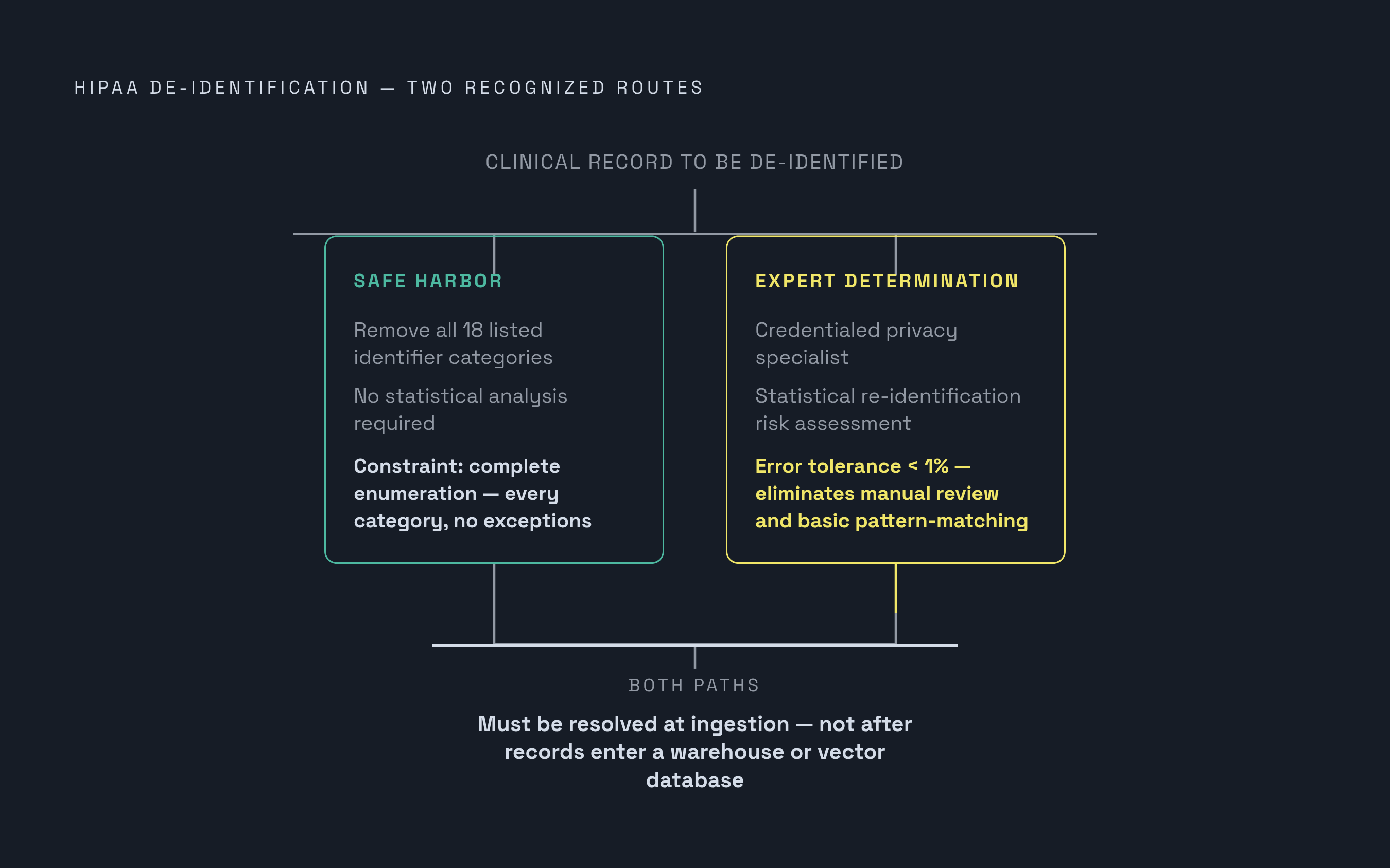
Under HIPAA, engineering teams can lawfully reach de-identified data by two paths, and every one of them demands its own choices before any record travels further downstream. Under Safe Harbor, all 18 categories of listed identifiers must be removed from the record. With Expert Determination, an accredited privacy specialist has to assess re-identification risk statistically and vouch that it remains very small. Either way, the choice has to be settled at ingestion. Neither option works as a late-stage cleanup once records have already been stored in warehouse storage or a vector database.
The Expert Determination route imposes a single decisive constraint on which tools qualify: an error tolerance below 1%. That limit disqualifies any de-identification method that depends on people checking records by hand, since reviewers cannot sustain such a low error rate when working through large quantities of clinical documents. It likewise excludes basic pattern-driven utilities, which spot standard identifier structures yet overlook telling particulars woven into prose.
Handling de-identification requires two distinct engineering steps, both of which the pipeline must support. The opening step is to detect PHI in the text. Next comes substitution: the pipeline can mask PHI by using generic placeholders, or obfuscate it by inserting plausible fabricated values of the same kind. That decision shapes the resulting dataset, so it should be chosen deliberately rather than left to the initial tool’s preset behavior.
Audit logs must be tamperproof and capture each pipeline access event, not only the outputs that a model creates. Consent controls have to be built into the pipeline. A patient's consent decision cannot live off to the side in a compliance repository checked now and then by the pipeline; it has to stay attached to the record so later models and API requests can see it. Data must be encrypted both while moving and while stored, and production systems should use AES-256 under organization-managed keys. Each AI vendor handling the data chain must sign the required Business Associate Agreement, while AI deployments also need breach reporting to include unauthorized entry through the AI system, such as prompt injection or model extraction attacks on the model.
State law adds obligations beyond the federal rules. Under Texas SB 1188, which took effect September 1, 2025, clinicians may use AI diagnostically provided they stay inside the boundaries of their license, no other statute forbids the practice, and all machine-generated records undergo review per the standards set by the Texas Medical Board. That statute also mandates informing patients about AI involvement, while from January 1, 2026 onward, EHR records must remain stored domestically. Every platform operating within Texas must follow these rules, demonstrating that clinical AI governance reaches far beyond HIPAA alone.
Ingestion-tier design: securing the entry point before data enters the pipeline
Every time you let data in too freely, that leniency shapes all the later work built on top of it. That is why ingestion tends to be the architectural point where the biggest compromises get made, usually well before anyone is choosing a model.
External EHR and pharmacy platforms must always reach the internal broker through an intermediary. Instead, the AWS blueprint catalogs a documented architecture decision, ADR-01, that puts an API Gateway, a web application firewall, plus an ingestion normalizer ahead of it. While this intermediary introduces latency, it enforces HMAC signature checks on payloads, blocks DDoS attacks, and validates each event's structure against FHIR R4 US-Core requirements before anything enters the pipeline. This is the deliberate compromise engineers face when designing these systems: tolerating marginally delayed ingestion to ensure that only validated, standards-compliant events flow into the processing stream rather than raw, untrusted data.
For production clinical NLP, use a stream-processing design that works from continuous events, not nightly batches. Each event should add its own immutable audit entry as it moves through the pipeline, recording the source data, the transformation applied to it, how identifiers were removed, and the ingestion time. Ordering is just as important here as speed. Use PatientId to assign Kafka records to partitions so each patient’s events are processed in exact first-in, first-out order, a necessary safeguard because if a medication discontinuation is handled ahead of the prescription creation it follows, any clinical safety model relying on that chronology can be corrupted.
Schema fragmentation is another compounding risk in this layer. Dispensing systems used by pharmacies often output vendor-specific JSON. HL7 v2 commonly arrives from hospital systems. Patient portals send the arbitrary payload their developers picked. At ingestion, the pipeline must translate every feed into a common exchange model, otherwise the system-wide schema collapses into ad hoc mappings that cannot be maintained for long. Zero-Trust separation of the network reduces lateral exposure: every call between compute and cloud-managed services within the VPC should use its own private VPC endpoint, so clinical data never needs the public internet to pass among internal services.
OCR-sourced material, whether faxed records, prior authorization forms, or intake questionnaires, adds a second tier of PHI that must be handled right where ingestion happens: both the picture and the text drawn from it contain identifying details, and each requires care. Amazon Textract is HIPAA-eligible. Azure Document Intelligence and Google's Cloud Vision service split encryption and logging duties between provider and customer in their own ways, so before you trust a service with clinical documents, verify where those responsibilities fall for each one yourself. The scanners and imaging hardware that generate the source material require physical and network protections of their own, since a scanner that has been compromised threatens the ingestion perimeter just as much as a hacked API endpoint does. Consent flags sit in this layer too: at ingestion, the patient's consent status must be bound to the record and then follow it through all downstream models and API calls, rather than being verified against some separate system elsewhere in the stack.
PHI de-identification at ingestion: what the pipeline must do to the text before it moves
De-identification stands as its own multi-step pipeline stage rather than one model invocation tacked onto ingestion's finish, and every record must wait for it to wrap up entirely before flowing onward to any subsequent storage or model. The regulatory rules covered above, rather than whatever is fastest to build, dictate the accuracy standard it must meet.
Clinical PHI shows up in several different modalities at the same time, and each one calls for de-identification handled differently: notes in free text, fields in the structured EHR, DICOM studies carrying PHI embedded in the pixels themselves, and recorded clinical audio. A pipeline restricted to text, on the assumption that images and audio can wait until some future stage, leaves itself exposed precisely where it claimed compliance.
Of these formats, free text gives you the most trouble. PHI in a discharge summary or pathology report never sits in a field you can point to ahead of time. Clinicians write names, dates, ID numbers, and locations straight into their sentences, hiding them inside normal narrative language. Once you process real volume, people reviewing records by hand mostly cannot meet the regulatory standard for mistakes. That means you have to de-identify with software to handle scale, not simply to save time.
Masking and obfuscation lead to different outcomes once data moves beyond this gate. With masking, the original identifier is reduced to a generic stand-in. In obfuscation, a believable value of the same kind takes the identifier's place, such as using an invented name instead of the actual one, so later analytics can still follow the document's story. The way substitutions are applied matters too: using one alias for each individual throughout a document preserves its internal logic and lets systems associate anonymized entries for that person across data feeds, formats, and time points while keeping the real identity hidden.
Relying solely on the 18 fields that HIPAA's Safe Harbor provision names is not enough. Live environments must additionally detect practitioner identities, facility titles, declared occupations, plus the broader demographic categories required under frameworks such as GDPR, since pipelines tailored exclusively for HIPAA compliance may still expose data governed by other regulations. DICOM files demand their own approach: de-identification must occur across pixels and metadata alike, preserving tags, shifting dates, and maintaining UID consistency so clinical utility survives the removal of identifying information.
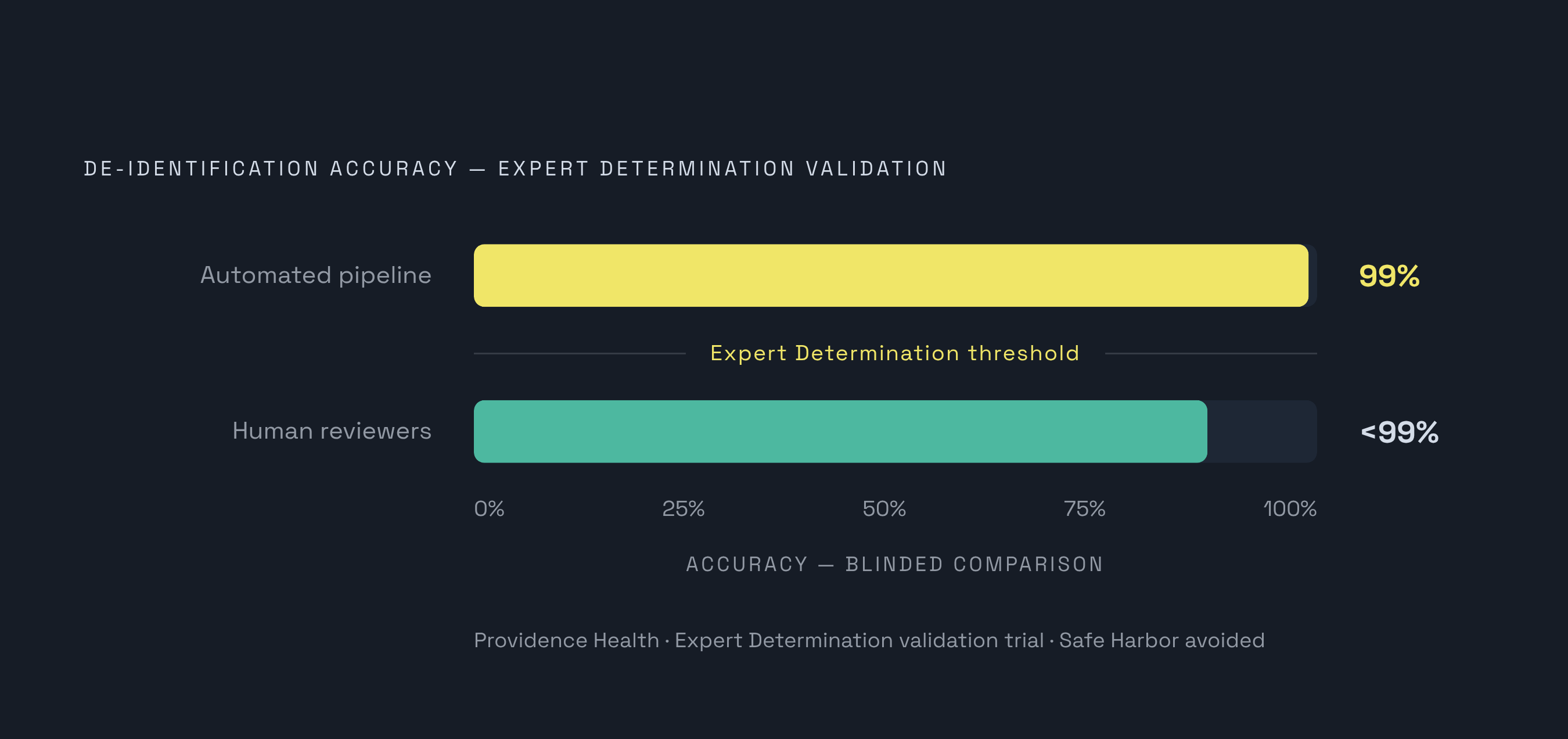
Providence Health's deployment offers a practical example of the discipline such pipelines require. A third-party privacy expert completed HIPAA's full Expert Determination review by analyzing the core technology, conducting the mandated statistical risk assessment, and checking real outputs after de-identification before confirming that the pipeline satisfied HIPAA's legal standard. In blinded comparisons with human experts, the system correctly de-identified records at a 99% rate, surpassing the reviewers' overall accuracy in the trial. That level of performance supports relying on Expert Determination rather than defaulting to Safe Harbor's tighter, more cautious rule set.
Notes
- Architecting Event-Driven Clinical NLP and Predictive AI on AWS: A HIPAA-Compliant FHIR Blueprint
Provided the FHIR-compliant AWS architecture details, including ADR-01, API Gateway, HMAC signature checks, Kafka partitioning, and the statistic that over 80% of vital medical information lives as unstructured text.
- Regulatory-Grade Medical Data De-Identification
Provided the sub-1% error tolerance requirement for Expert Determination, the multimodal de-identification requirements covering DICOM and clinical audio, and the need to detect identifiers beyond HIPAA's 18 Safe Harbor fields.
- Patient Journey Intelligence - John Snow Labs
Provided details on Providence Health's Expert Determination validation, including the 99% de-identification accuracy figure and the blinded comparison with human experts.
Every new piece from The Parse Layer, as it's published.
Follow