Audit Trails and Provenance Tracking in Document AI Systems
Regulators now require Document AI systems to log the reasoning behind every decision.

When oversight from regulatory or judicial quarters seeks the basis for a Document AI platform's specific output, an API log extraction fails to provide it. The log records the call itself, the endpoint touched, and the response returned. It will not reveal the reasoning behind one choice over the alternatives the model had open to it, and that gap is precisely the issue at stake here.
Document AI systems operate within workflows that mix application code, outside tools, document-store retrieval, and a model generating probabilistic output. Finding the root of an error in such a setup proves more difficult than with conventional programs, since deterministic code maps each input to one result and stack traces pinpoint failures. Typical server logs merely note that a query arrived, an answer departed, and the exact time of each. Such logs omit the logic linking those events. In deterministic setups, this omission seldom causes trouble since execution routes remain static and open to review. Yet when a model selects from likely next steps, that missing reasoning becomes the auditor's core concern, which simple input-output records cannot resolve.
Regulatory and enforcement events that converted traceability into a legal obligation
By early 2026, three events had put a firm deadline on closing that evidentiary gap. COSO’s February 23, 2026 report, “Achieving Effective Internal Control Over Generative AI,” framed AI monitoring as requiring a full audit trail that captures prompts, inputs and outputs, model and setup versioning, plus proof of human review, so teams can recreate the system’s basis for action and confirm the control operated as intended when it mattered. That sets a concrete threshold rather than issuing another broad push for better documentation.
A specialized team to enforce SOX against auditors who misbehave was created by the SEC on March 19, 2026, promising harsher sanctions and zero tolerance for weak financial reporting safeguards. Since this scrutiny encompasses AI-touched controls, any firm using machine learning for reporting or payment approvals must demonstrate those systems operated as intended.
The compliance calendar under the EU AI Act moved back, but the obligations stayed firm. High-risk-system obligations in Annex III first pointed to August 2026, until the Digital Omnibus’s AI measures reset the date as December 2, 2027, with a later EU regulation sequencing when particular high-risk systems must comply. Under the Act’s logging rule, deployers must retain logs for a minimum of six months, documenting how activity can be traced, whether inputs were accurate, who the relevant natural persons were, and which reference database was used. Where the Act treats a contract-review or document-sorting system as high risk, it must capture model versions, state the basis for each outcome, flag every point of human review, and keep those records through the same six-month period so the full route from source material to final result can be rebuilt.
Training data became another thing courts will review directly. In July 2026, Hachette Book Group sued Google alongside Cengage and Elsevier, with Scott Turow also joining the challenge to Gemini training on books and scholarly material. Whichever way it ends, the case shows a Gemini training set to be a documentable fact opposing counsel can challenge, not an internal point a vendor can dismiss as proprietary. Together, these three changes put any Document AI system used in regulated decisions under named enforcers and a set calendar, rather than just a voluntary standard for good practice.
What a complete audit trail must capture
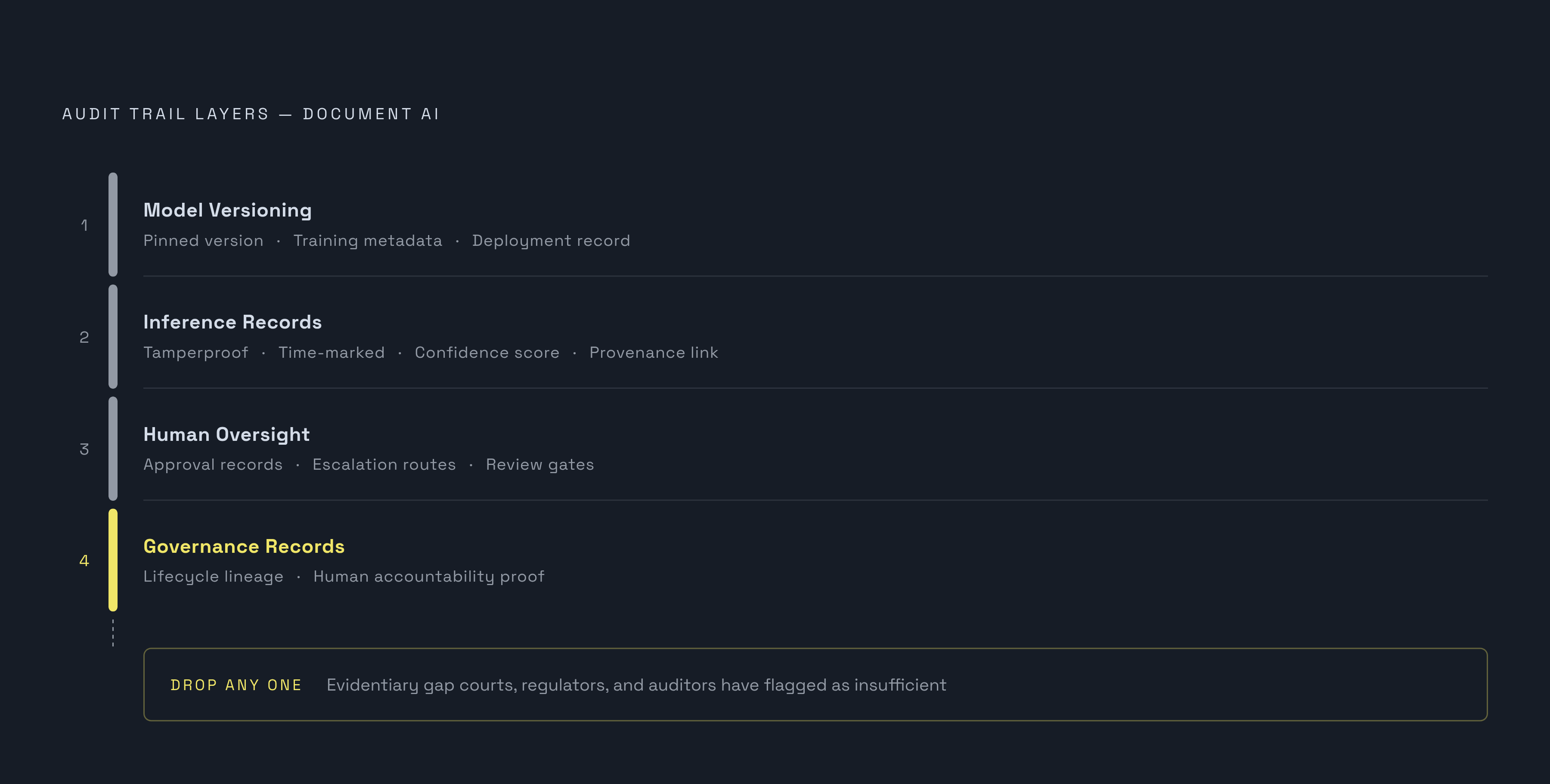
To hit that standard, an audit trail needs four distinct layers, and dropping any one produces the gap that courts, regulators, and auditors have flagged as insufficient.
The first layer covers model versioning and the technical record behind it. A label as vague as "GPT-based classifier" gives an auditor nothing to act on, so what's needed is a pinned version tied to the model and configuration that produced the decision. Ojewale, together with Suresh and Venkatasubramanian, sketch a framework that records training, evaluation, and deployment as distinct event types, each carrying the metadata it requires. That structure gives the auditor the opening answer: which model, and in which state, generated this output?
At the second layer, the system records decisions and inferences. Each record must be tamperproof and time-marked, sealed cryptographically, with separate fields for when it was made, where the input came from, which model and version produced it, its confidence score, source-material provenance link, and any human-override status. The system-generated confidence score is merely a numeric signal, so relying on a high value as the rationale itself is a known failure pattern. The log must preserve how the system arrived at its result, rather than just the result’s own stated level of confidence.
The third layer focuses on human oversight: approval records, escalation routes, and scheduled review gates. Sirion shows this chain through its contract AI traceability framework: input data is handled by the model, yielding a contract recommendation before human validation turns it into a contract update, while every step keeps records that support accountability and later reconstruction of the result.
Taken together, these layers form one unified whole. The lifecycle framework pairs the technical lineage (models and the datasets, training cycles, deployment stages, and continuous oversight behind them) with the governance records that prove a real human was answerable for what took place. Neither side can stand in for the other. When a regulator examines an AI-touched control, written policies asserting correct behavior fall short, because no document can establish what a system did at the precise instant a particular decision was rendered. What regulators want instead is observable evidence at runtime: which assets the system engaged, what safeguards were in play, and whether those safeguards actually engaged.
The individual-attribution gap: why service account logging fails every major framework
Enterprise AI deployments most often fail compliance in the easiest way to describe. Whenever regulated information is reached via shared API keys or service accounts, nothing in the audit trail identifies the specific person who initiated it. All leading regulatory standards, HIPAA among them alongside GDPR and SOX, contain provisions that this practice directly violates.
Under HIPAA each user must be identified separately, and GDPR's accountability principle alongside SOX's audit trail requirements likewise demand that any action be tied to a specific individual; a service account, built to stand in for a system rather than a person, cannot meet that demand by design. Picture a SOX auditor asking which employee steered an AI-automated payment; the truthful reply, where service-account logging is the foundation, is that a service account initiated the payment while no record identifies the human whose session launched the sequence of events that ended there. Regulators are now classifying that response as a primary breach rather than a minor paperwork issue to acknowledge and overlook.
Because attribution hinges on it, timestamping imposes its own quiet demand. NTP alignment between machines has become standard, and an auditor will no longer disregard temporal inconsistencies on systems producing these entries, since records lacking a trustworthy chronological sequence cannot be verified. The framework detailed above mandates that each lifecycle event be tied to an accountable individual, preserving evidence of who authorized a modification, the circumstances surrounding that authorization, and the justification provided, rather than merely documenting that an alteration occurred.
This gap is not only about financial controls. That architecture undermines SOX attribution, prevents dependable records of who accessed PHI under HIPAA, and leaves banking adverse-action explainability obligations unmet. If users act through service accounts or reused logins, none of the three frameworks can be satisfied because the same attribution flaw persists, making the issue a design defect, not some option an administrator left unconfigured.
Explainability and auditability as different problems
Document AI may offer a complete rationale for what it recommends yet remain beyond auditing, since explainability concerns the output whereas auditability concerns the controls surrounding it. Each addresses a separate concern, so solving one leaves the other unresolved.
An AI might be asked to explain why it flagged a contract clause, yet leave behind no evidence of who looked at that flag, how it was reviewed, what approval it gathered, or what was ultimately done with it. Explainability tools, as the saying goes, answer "what did the model do, and why did it say it did that." They shed no light on who authorized what followed from it, what framework the sign-off sat within, or whether that framework was enforced in practice. Ojewale and colleagues are explicit on this point: a complete audit trail demands both the technical lineage of the output and the records of oversight surrounding it, while an explainability layer, no matter how polished, addresses only the first half.
Static documentation artifacts hit the same wall. A model card, a datasheet, or a system card is a curated snapshot, typically capturing how a model looked when it shipped. The document breaks the instant a fresh model version enters production with no matching card update, and in a rapidly evolving Document AI deployment, this occurs frequently.
Record-keeping designed mainly to keep a regulator happy can turn oversight inside out rather than enable it, generating compliance documents that read as authoritative on paper even when the trail of decisions behind them remains hidden. A static policy PDF and a once-a-year review may look fine on a shelf, yet both fall short the moment a regulatory exam demands live proof of how the system actually ran. For enterprise contracting, real traceability requires combining structured provenance, tamper-evident records, an explainable AI architecture, and direct workflow-level insight, since these are mandatory elements of a single integrated system rather than interchangeable approaches to the same outcome.
How agentic systems break existing log architectures
Agentic setups intensify the problem, since a model coordinating tool use, retrieval, and sub-agent requests leaves behind a decision trail that cannot be pieced together from any one component log alone. Accountability arises at the system level, across interacting pieces no individual vendor or team planned from start to finish.
Each vendor in that chain keeps decent records for its own product, but it can see only its own part of the activity. Hardly any vendor captures which outside records or documents the agent accessed as it crossed another provider's environment. The outcome is separate, self-consistent logs for each component, but the handoff points between systems leave holes that stop investigators from rebuilding the full path.
Ojewale's team proposes an architecture with lightweight emitters writing to an immutable audit log, plus an auditor interface that follows requests between organizations. The audit layer must track a request across its full lifecycle as it crosses system boundaries, rather than instrumenting components separately and hoping they align later. OpenLineage standardizes pipeline lineage and Apache Atlas supplies business metadata with field-level tracking, yet both work more broadly than single model or tool invocations, so they form the necessary foundation for the detailed resolution agentic systems demand.
There is now a standards-track way to handle this problem. IETF draft-sharif-agent-audit-trail-06, revised September 29, 2026, defines each record as JSON-based, and makes fields mandatory for agent identity, action classification, action outcome, and trust-level scoring. RFC 8785 canonicalized SHA-256 hashes chain the records to reveal tampering, while optional ECDSA signatures can provide non-repudiable proof, and post-quantum ML-DSA-65 (FIPS 204) signatures are supported alongside optional RFC 6962 Merkle batch anchoring. It also requires pre-execution creation of the record for the described action, while treating a lowered trust rating for any consequential action as a separate attributable entry.
Other studies highlight a more subtle flaw affecting such architectures. Case (2026) illustrates how uniform matching criteria can leave every isolated entry technically valid, even as the stated equivalence structure drifts away from what is truly enforced. Such reviews may yield non-monotone results, since examining a longer sequence of changes can expose fresh mismatches in previously approved entries. Platforms may seem flawless during inspection yet conceal deviations that emerge only as additional records pile up.
When immutability and cryptographic sealing are required
Cryptographic sealing lets later readers detect whether a record has been altered. Whether the entries have stayed intact and whether the log includes everything required must be handled as distinct questions, with neither treated as a byproduct of the other, since sealing cannot fill gaps in the record.
That draft for auditing agents illustrates both halves of that split in practice. It chains records together with a SHA-256 hash under RFC 8785, so removing or changing even one record snaps the chain and exposes the gap. Where applied, optional ECDSA alongside ML-DSA signing prevents later denial by the author, while a key identifier called signer_kid per RFC 7638 independently identifies the principal behind each entry without relying on what that record contains. All such measures guard against later alteration. None of it addresses whether the record held the right information when it was written.
The draft's discussion of decision reproducibility sharpens the boundary: record reproducibility applies to any model regardless of its construction or rollout, while decision reproducibility exists only when open-weight models operate at temperature zero under attestation. The attestation digest must bind the model weights, tokenizer, chat template, inference engine build, decoding configuration, and numeric environment as a single set. Omit even one required element from attestation, and it can carry a forged or changed result past review unnoticed. A cryptographic seal on the record shows only that its contents have not been altered since creation. It does not show that the original capture included every material detail; the audit architecture for Document AI must address that issue independently.
Sources
- draft-sharif-agent-audit-trail-06 - Agent Audit Trail: A Standard Logging Format for Autonomous AI Systems
- Operational Identity: A Finite Audit of Declared and Implemented Rules of Sameness
- Audit Trails for Accountability in Large Language Models
- AI Regulation 2026: Current Laws, Compliance Requirements, and What's Next
- AI Governance Documentation: Essential Audit Evidence Guide
- Explainable AI: The Complete Enterprise Guide for 2026
- From Agent Traces to Trust: Evidence Tracing and Execution Provenance in LLM Agents
- Correct Is Not Governed: Provenance Integrity in Agentic Workflows