Chunk Size Optimization for Long-Context Enterprise Documents
Fixed-size chunks outperform semantic chunking for most enterprise RAG pipelines.

These benchmarks shape most talk about chunk size now, but their results differ because they tested different things. In February 2026, Vecta and FloTorch put 50 academic studies through a full pipeline to see if the output was right under a set word limit, not just if it pulled a useful piece. NVIDIA's 2024 study tested five datasets like FinanceBench for answer accuracy via RAGAS at token ranges of 128 to 2,048, keeping factoid and analytical items separate instead of merged. Chroma Research measured a narrower thing: token-level recall in retrieval, meaning how much of the right answer shows up inside what the retriever hands back, before the model does anything with it afterward. Superlinked's VectorHub benchmark tested HotpotQA, SQuAD and QuAC, covering multi-hop, extractive, conversational tasks, and scored chunker-and-retriever setups by MRR plus Recall@10.
Put side by side, these results mostly stop looking contradictory. FloTorch's run showed semantic chunking creating fragments averaging only 43 tokens. Those chunks retrieved cleanly, but the limited context affected downstream accuracy. But with 43 tokens, a system had too little to make a reply from; FloTorch's full-pipeline score for that setup was 54%. A chunk can nail recall and still fail if the model can't turn it into a correct response. Groups that optimize only for recall are optimizing the wrong step.
Vectara's NAACL 2025 paper checked 25 chunking configurations with 48 embedding setups to make this clear (see arXiv:2410.13070). On real document collections, fixed-size chunking did as well as or better than semantic chunking for document retrieval, retrieval, and answer work, while semantic chunking's few gains didn't make the extra compute worthwhile computationally. The sophisticated method got beat by the plain one more than the hype would indicate. Most groups pick the more complex option by default. That instinct is wrong: the simple method comes out ahead where it matters, so anyone asking for extra compute to run semantic splitting has to justify it.
The 512-token recursive default's strengths and its ceiling
The configuration validated in the widest 2025 to 2026 benchmarks is 512-token chunks using 10 to 20% overlap, split recursively. FloTorch's 50-paper review showed this configuration hitting 69% accuracy, outperforming other strategies in the benchmark. Groups without evaluation data or the hours to collect it should launch this config and proceed. Without a baseline, arguing over chunk strategy addresses the wrong issue.
Recursive character splitting works with breakpoints in a hierarchy, preserving more of the document's structure. It starts with paragraph breaks, moves to sentence breaks, then boundaries, and only resorts to character-level cutting if nothing cleaner is available. It preserves much more of the document's form, with no extra compute cost beyond what a naive splitter uses.
Overlap pulls its weight where chunks meet. Leave it out and any text spanning two chunks falls apart: the first piece has no actor, the second no verb. But overlap has a cost. Set too much overlap, and cost and embedding compute rise while near-duplicate content fills the context from nearby chunks. On FinanceBench with 1,024-token chunks, NVIDIA ran overlap at 10%, 15%, and 20%, and 15% came out on top. The research doesn't show going beyond 20% buys value, and groups doing it are often solving fear, not a measured issue.
That doesn't mean 512 tokens fits every situation. It works with homogeneous prose: help desk cases, product descriptions, press releases, text that stays consistent paragraph to paragraph. It suits pipelines processing large volumes under a tight latency constraint, fast prototyping, and any group still lacking labeled evaluation data. Beyond that, use it as a baseline.
Query type as the first branching condition: factoid vs. analytical vs. multi-hop
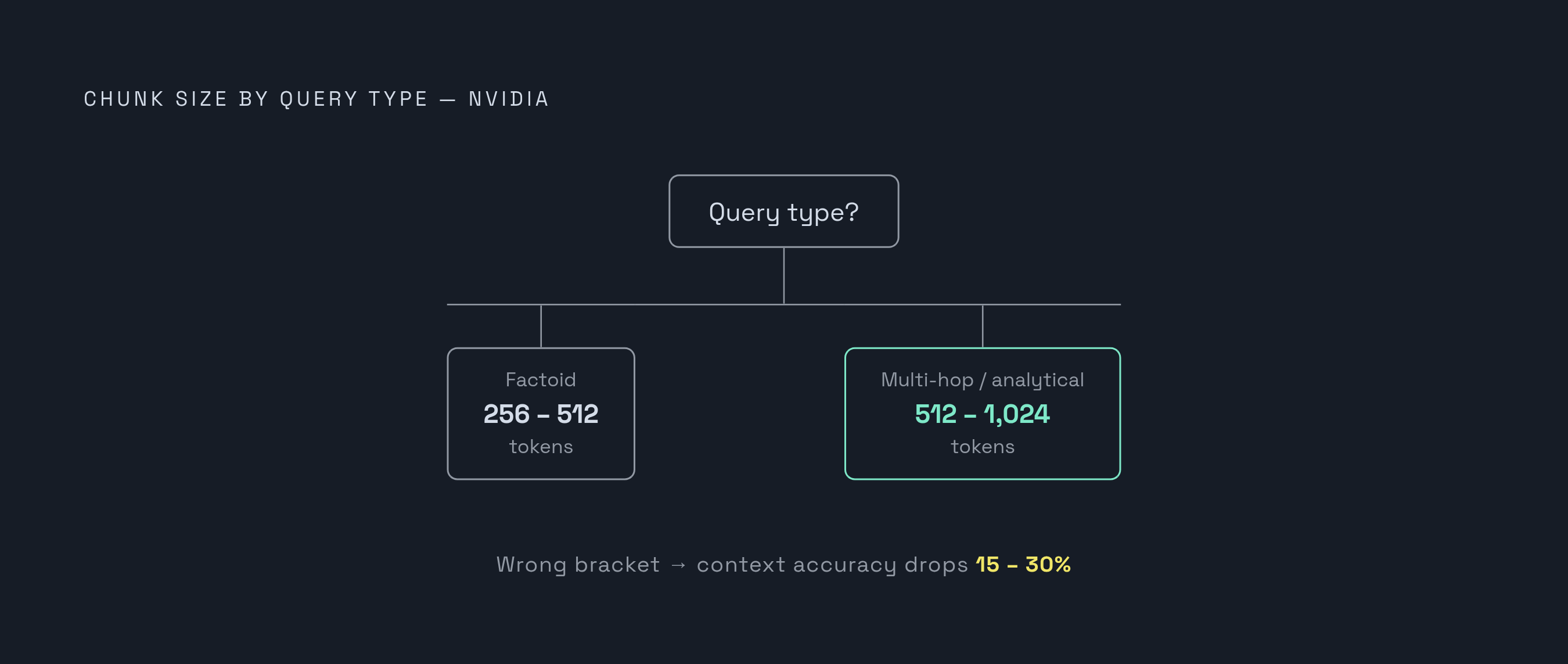
NVIDIA's research surfaced a point most chunking guides miss: the answer affects chunk size nearly as strongly as the document's nature. Factoid queries, lookups for one fact, give the strongest results with chunks of 256 to 512 tokens. For Multi-hop analytical queries pulling several facts stitched from different parts, stick to 512 to 1,024 tokens. Land one bracket off and context accuracy falls 15 to 30% in NVIDIA's own testing, no small rounding slip on a production setup.
The factoid outcome follows logically. A tight chunk with one exact fact lines up well with a tight query for the embedding model, and lets a downstream model pull the answer out cleanly. Fill a chunk with surrounding words and the embedding becomes diluted, so the one with the answer might drop below another just close to the subject.
Multi-hop queries flip this logic. The logic depends on a few facts living near each other so the model can move through them without losing context, and a chunk boundary splitting things mid-sequence breaks the inference. A study showed sentence-by-sentence chunks matched meaning-based chunks up to around 5,000 tokens while using much less processing, making them a practical compromise for groups handling simple facts and brief analysis. Start with the query pattern. That decision sets the chunk size.
Document-type-aware chunking rules for the five enterprise formats that break generic splitters
Recursive character splitting handles prose and falls apart on almost everything beyond it. Five enterprise document formats call for their own rules, and a standard splitter can make production RAG bleed accuracy, for months before someone traces the bad answer to its chunk boundary.
Agreements, rules, SOPs all need splitting at the provision level, since that's what actually carries meaning in these documents rather than a block of lines or set word limit. When a clause boundary divides a duty, the retriever fetches only part of a contractual commitment, with no indication the result is incomplete. In regulatory work, this is the critical risk: treating a partial obligation as complete does more damage than returning nothing.
Healthcare and regulatory texts reveal the most dramatic data split, bringing real-world consequences into focus. A peer-reviewed CDS trial showed adaptive chunking, set to boundaries instead of token, reached 87% accuracy versus a 13% fixed-size baseline (p=0.001). That difference means a clinician can trust the tool or must double-check all its output, undermining its purpose. One piece is structural: semantic splitters often produce pieces under 100 tokens that lack the context to be useful, and a firm chunk-size threshold recovers most accuracy lost to breaking text up too far.
PDFs work another way too. In NVIDIA's 2024 benchmark, page-level chunking achieved 0.648 accuracy on the datasets and less variance than any other strategy, because in this kind of document the page itself controls the layout, and footnotes and disclosures stay inside those borders. Using 1,024-token fixed-size pieces on those same files reached 57.9% accuracy, a steep fall that comes from overlooking how the pages are laid out. At ICSE-SEIP '26 in Rio de Janeiro, a 2026 IEEE/ACM paper examined chunking and PDF parsing in finance QA and found that structure-aware parsing improves accuracy in finance QA, suggesting it should not be treated as optional.
Hierarchical parent-child chunking: the production pattern that resolves the precision-context tradeoff
Tiny chunks pull the right text but leave a model without context. Bigger chunks let a model think things through, but they dilute retrieval accuracy in the process. Many teams treat the 512-token default as a settled answer that bridges the two failure modes, and that is exactly where they get stuck.
This nested setup avoids the tradeoff by breaking the work into separate levels rather than forcing one block length to handle everything. Tiny chunks take care of retrieval, so embedding gets a tight fit to the query. The bigger chunks that wrap around the hit go to the model, supplying enough surrounding context to build a coherent answer. Two index layers have to be kept instead of one. That cost buys results: The pattern ranks highly in retrieval evaluation benchmarks and has become a common production approach.
That's where the cost trips most teams up. Both index layers call for refreshing whenever documents are updated, so freshness checks go from being optional to a prerequisite. Teams describe spending several months iterating on chunking to achieve reliable results. That's the true cost of the system, and anyone weighing it should plan for that expense upfront rather than find it during the rollout.
Late chunking and contextual retrieval: when cross-section dependencies matter
Big documents trigger a failure mode that the default 512-token setting and hierarchical chunking both fail to resolve. A passage can read fine on its own and still lack the crucial detail from three sections back that gives it significance. Both Late chunking and the approach called contextual retrieval tackle this in two different ways, so they're not interchangeable.
Late chunking flips how the steps usually run. Rather than splitting a document to embed each part, it passes the whole text through an embedding model built for long-context and afterward splits the token output into chunks by mean-pooling. Each chunk keeps its ties to far-off context, since it was built with the whole text still in view. It suits research papers, legal contracts, and technical manuals: texts where a term introduced later only makes sense with context from earlier pages. The tradeoff comes upfront. It calls for a wide-window representation system upfront, and prep takes more work than the usual dividing pass.
Contextual retrieval offers an easier path toward the same end. Putting contextual details into chunks before embedding reduced top-20 retrieval failures by 35% in Anthropic's benchmark, and it's much safer to roll out than late chunking because it layers onto a chunking pipeline instead, no rebuild needed. Atlan's 2026 enterprise guide calls it "low risk, meaningful accuracy gain," which is about right for teams that want a real bump in accuracy without tearing down what's already running.
Picking either one by default won't pay off across the board. In high-value corpora: research files and law work with lots of cross-referencing, they earn their keep, as in any setup that has a measured retrieval failure that hurts the company. For uniform text, large-scale pipelines constrained by latency, and any group still without a usable retrieval baseline, these techniques are overkill. Figuring out which bucket it belongs in is the real work, and skipping that check is how teams start bolting late chunking to a support-ticket pipeline with no use for it.
Sources
- RAG Chunking Strategies & Embeddings Optimization: The 2026 Benchmark Guide
- RAG Chunking Strategies: The 2026 Benchmark Guide
- Chunking Strategies for RAG: Methods, Trade-offs & Best Practices
- Best Chunking Strategies for RAG (and LLMs) in 2026
- A Systematic Investigation of Document Chunking Strategies and Embedding Sensitivity
- Rethinking Chunk Size For Long-Document Retrieval: A Multi-Dataset Analysis
- Rethinking Chunk Size For Long-Document Retrieval: A Multi-Dataset Analysis
- (PDF) Rethinking Chunk Size For Long-Document Retrieval: A Multi-Dataset Analysis